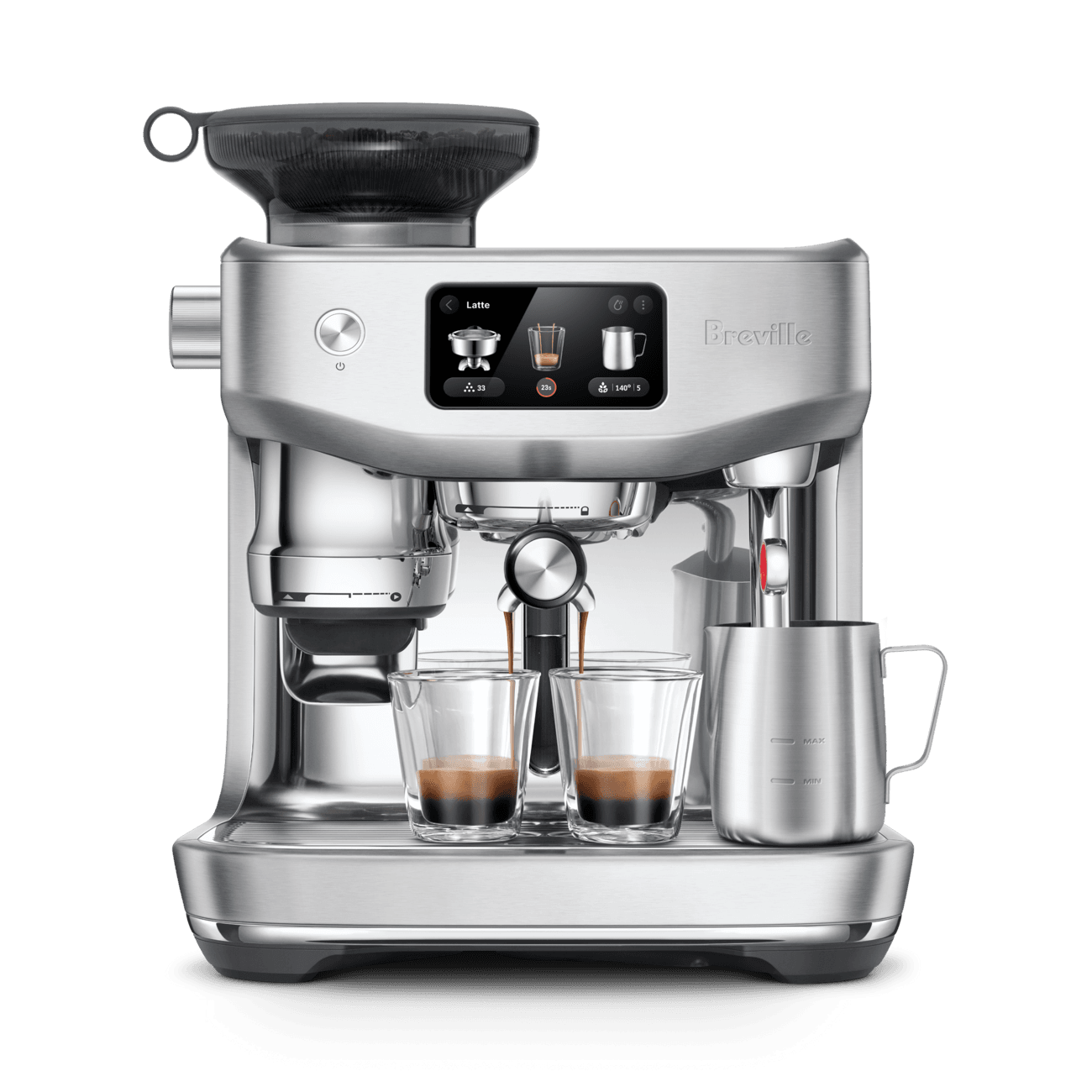
I made my first latte on this thing about forty minutes after taking it out of the box, which is roughly forty minutes faster than I have managed on any previous Breville. The Jet's setup wizard walks you through the grind dial, the dose, and a calibration shot, and by the third pull the on-screen guidance had me dialed in well enough that the milk was the only weak link in my flat white. That was me, not the machine.
The Jet sits in an awkward spot in Breville's lineup. It is more automated than the Barista Express Impress and less automated than the Oracle Touch. The grinder is built in and grinds directly into the portafilter. The tamping is automatic. The steam wand is also automatic: you put a thermometer-equipped pitcher under it, pick a temperature and a foam level on the touchscreen, and walk away. For my morning routine, this matters. I make one cortado, get dressed while the milk steams, come back, pour. The machine is faster than I am.
The shots are honestly good. Not La Marzocco good, but good. The ThermoJet heater hits temperature in about three seconds from cold, which is the marquee feature and also the one I underestimated until I lived with it. No more waiting fifteen minutes from cold start. I make exactly one shot some mornings and it's the same shot I'd have gotten thirty minutes in.
The milk is where the auto-steam earns or doesn't earn its keep. For flat whites and cortados it nails the texture within a couple of degrees of what I'd dial in by ear. For latte art, it's slightly less dense than what I can do manually on a better wand. Most people will not notice the difference. People who care about latte art already know they care about latte art.
The complaints are real. The touchscreen is a touchscreen, which means fingerprints, occasional unresponsiveness, and a UI that someone re-skinned between firmware updates. The water tank is mid-sized and lives in the back, which is fine if the machine isn't pushed against a wall. The grinder is built into the machine, which is convenient until it needs cleaning, at which point it's a chore. And the cleaning cycles want to run more often than I'd like; the machine nags.
The other catch is the bean compatibility. Like most Brevilles, the Jet's grinder is happiest with medium and dark roasts. Light Ethiopian beans turn into a slightly sour, slightly thin shot no matter what grind setting I use. I switched to a darker roast and the shots improved more than any single setting change ever did.
The value question is the real question. At around $2,000 you are paying about $1,200 more than the Barista Express Impress for the auto-steam, the touchscreen, and the ThermoJet. If you make milk drinks for two people every morning, the auto-steam alone is worth it; you'll get the time back inside a year. If you mostly drink straight espresso, save the money and put it into beans.
Verdict: Buy this if you make milk drinks daily, you want to walk away while the milk steams, and you don't want to learn to tamp.