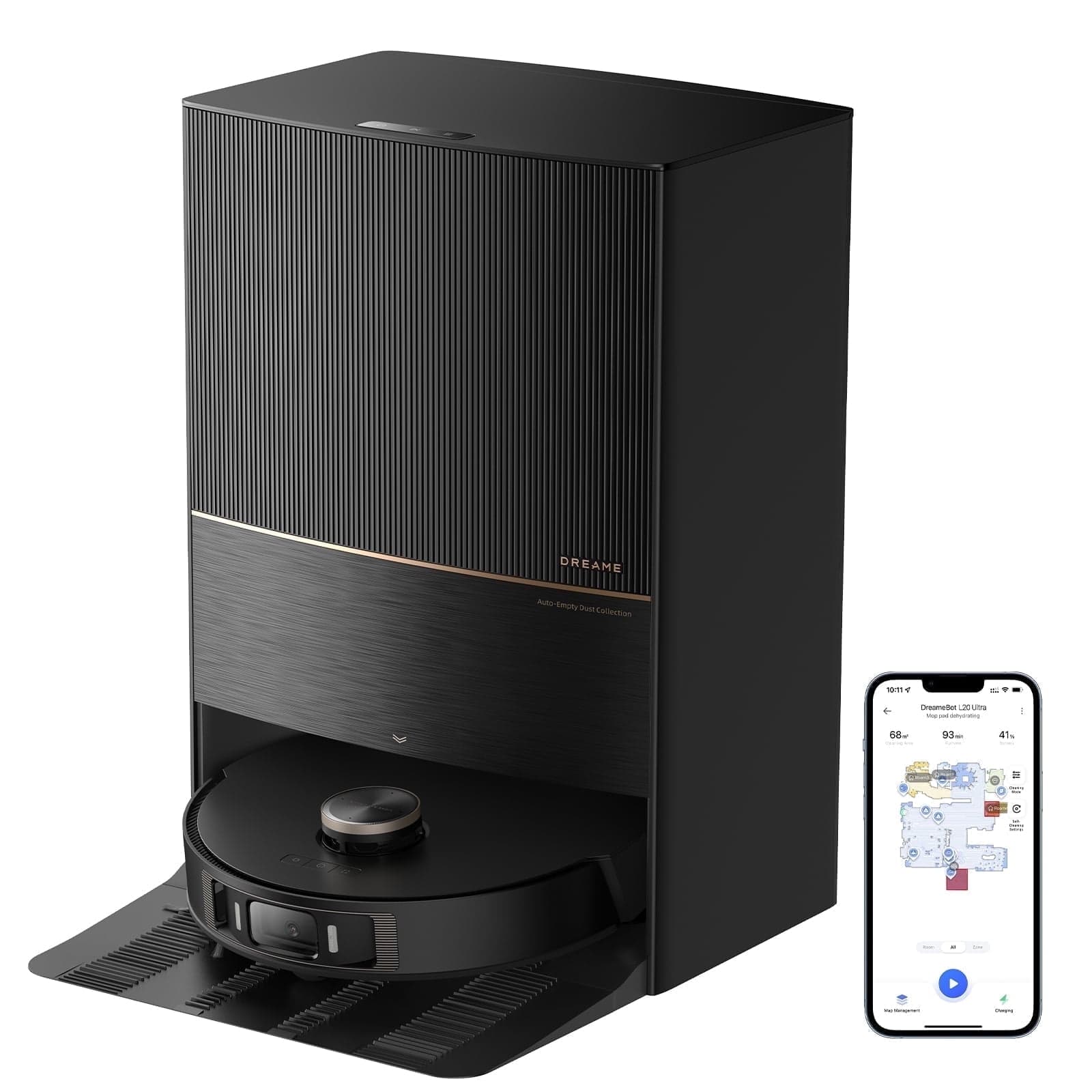
Every spinning-pad robot I've owned leaves a one-inch strip of dust along the baseboards that I have to mop by hand. The L20 Ultra is the first one that doesn't. There's a small motorized arm that pushes one of the spinning pads outward when it detects a wall, and once you've watched it work along a kitchen toe-kick you understand why the marketing leans on it. It's the rare robot vacuum feature that I actually noticed in daily use.
The dock is the other thing worth paying for. It empties the dustbin into a 3.2L bag that I changed once in roughly ten weeks, washes the mop pads after each run, dries them with warm air so they don't sour, and refills the clean water tank from a separate reservoir. The first week I kept opening the lid to check on it like a worried parent. After that I stopped thinking about it, which is the actual point of a robot vacuum.
Navigation is fast and confident. The LiDAR maps a floor in a few minutes and the structured-light obstacle avoidance correctly routed around a laptop charger I'd left coiled on the floor, a pair of running shoes, and a dog bed. It misidentified a dark rug edge as a step exactly once in two months, which is a better hit rate than the last three robots I owned.
The weak spots are in the cleaning, not the choreography. On hardwood the L20 is excellent. On my low-pile rug it's competent. On the medium-pile rug in the bedroom it never quite gets into the fiber the way a stick vacuum does, and the carpet score in independent testing matches what I see. If most of your house is real carpet, this is not the robot for you and probably no robot is.
Crevice cleaning is also middling. The brush bar is fine on open floor and surprisingly tangle-resistant given how much dog hair this house generates, but it doesn't pull dust out of the gap between the baseboard and the floor the way a crevice tool on a stick vacuum can. The MopExtend arm covers the floor next to the baseboard, which is the more important problem, but it doesn't excuse the other one.
The dock is enormous. Mine sits in a hallway because there is no corner of any room it would visibly fit into. Battery is rated for around 1,600 square feet on a charge, which covers my downstairs comfortably and means upstairs needs a second run. And the camera-based recognition is fine if you trust the company to handle the footage well; if you don't, this is not the robot for you either.
The price is the same as a Roborock S8 Pro Ultra, which is the obvious comparison. The Roborock mops slightly better in side-by-side reviews. The L20 cleans the edges. Pick the one whose weakness you can live with.
Verdict: Buy this if you live on hardwood with a few rugs and you specifically want a robot that cleans the inch next to the wall. If your home is mostly carpet, get a corded stick vacuum and stop here.