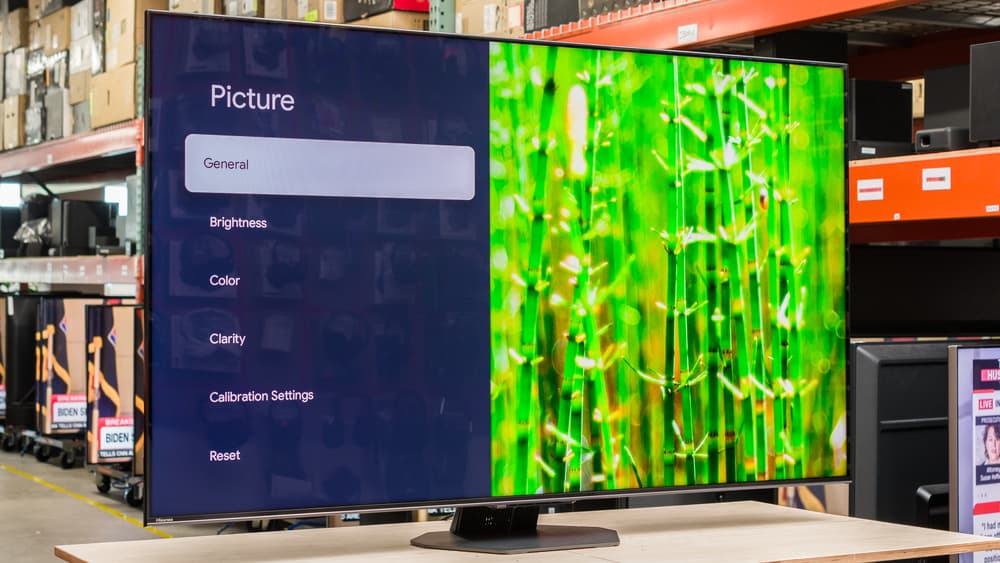
I bought the U8N for the room in our house with the worst lighting situation: floor-to-ceiling windows on two sides, no curtains, afternoon sun. Every TV I'd had in that room looked washed out by 3pm. This one doesn't, and the moment I realized that — sitting on the couch with the sun on the wall behind me, watching a daytime baseball game that I could actually see — was the moment I stopped researching alternatives.
The headline number is 3,000 nits of peak brightness across 2,000 dimming zones, and yes, in a sunny room you can feel the difference. HDR on this thing isn't a marketing claim. Highlights in a movie scene actually punch; sun glints off water look like sun glints off water. The quantum-dot panel hits saturation levels I'd previously only seen on OLEDs, and color volume holds up at the high end of the brightness range, which is where most cheaper QLEDs collapse into a yellowish wash.
What I didn't expect to care about was the gaming side. Dolby Vision Gaming on the Xbox Series X is something Samsung's lineup still refuses to support, and it's a real, visible thing — HDR games look noticeably better with DV than HDR10. Native 144Hz, VRR, ALLM, FreeSync Premium Pro, G-Sync — the spec sheet reads like a PC monitor, and in practice the TV behaves like one. I plugged a gaming laptop into it for a weekend and didn't go back to the desk monitor.
The Hisense weakness is the same one it has been for three generations: viewing angle. If you sit straight in front of it, the picture is excellent. If you're on the far end of a wide couch, or standing in the kitchen looking through to the living room, you'll see colors shift and contrast drop. The TCL QM8 handles off-axis slightly better in the same tier. If your seating is a face-on recliner or a normal couch in a normal living room, you won't notice. If your couch is one of those huge sectional pieces that wraps around the room, you will.
Google TV is fine, but the home screen has gotten ad-heavy in a way that genuinely bothers me. I'd rather pay another fifty dollars at checkout and not be sold a Hulu trial every time I press the home button. The built-in 2.1.2 audio is okay — better than the average flat-panel speaker, not better than even a cheap soundbar. Treat it as a stopgap and budget for a Sonos Beam or equivalent.
The other thing worth mentioning is the price relative to the U7N and U6N. Hisense will happily sell you a step-down model with most of the same chassis and a fraction of the dimming zones. The U8N is worth the upcharge if you live in a bright room or watch HDR content seriously. If your viewing is mostly cable news and Netflix in a dim den, the U7N gets you 80% of the experience.
Verdict: Buy the U8N if your living room is bright, you sit face-on, and you've been waiting for a Mini-LED that earns its keep against the OLEDs. If your couch is wide or your room is dim, the TCL QM8 is a closer call.