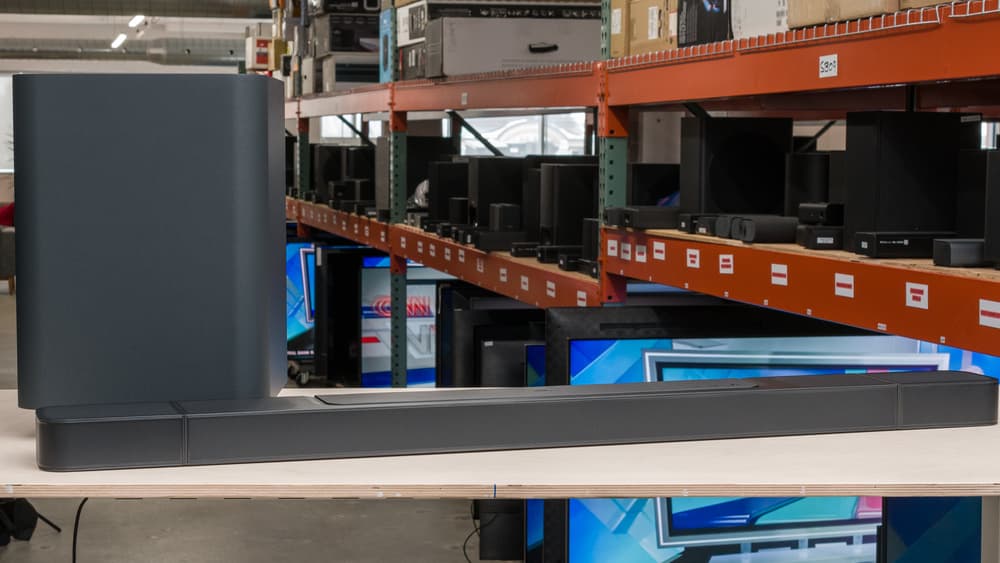
The first time I unclipped the rear speakers and walked them across the living room, I felt slightly silly and then immediately sold. There is no speaker wire in my apartment. There is no second outlet behind the couch. The Bar 1000 spends its weekdays as a normal soundbar with magnetic end caps in place, and on movie nights it splits into a 7.1.4 system without my landlord ever knowing.
The rears charge while docked and run on battery (about ten hours, which is more than any movie I'm willing to sit through). USB-C tops them up if I forget. The end caps that cover the exposed sides of the bar when the rears are off are a small design choice that suggests somebody at JBL has actually lived with a soundbar, because every other detachable system I've seen leaves you staring at raw connectors.
The 10" wireless subwoofer is the sleeper. It's bigger than the matching subs from Bose and Sonos, and on John Wick: Chapter 4 it gave me the kind of chest-thump I associate with proper home-theater sub-and-receiver setups. Music streamed over Bluetooth got more three-dimensional than I expected once I leaned into Atmos tracks. Standard stereo music is fine, not magic.
The honest weakness is the rears at high volume. Even pinned to the ceiling of their range, they don't quite keep up with how loud the bar and sub can play together. If you're the kind of person who watches Mad Max: Fury Road at reference volume, you'll notice the surrounds falling behind the front stage in the last act. For TV, casual movies, and most music, they're fine. For the kind of demo material that justifies buying a 7.1.4 system in the first place, they're the bottleneck.
Setup leans hard on the JBL One app, which is functional but not graceful. The first pairing took two restarts before the rears showed up. After that, everything just worked, including the auto-calibration routine that asks you to hold a phone in the listening position and stay still for a minute. The bar's three HDMI inputs are an actual luxury — I have a switch I no longer need.
Format coverage is generous. Dolby Atmos and DTS:X both decode natively, and on a 4K Blu-ray of Blade Runner 2049 the DTS:X mix landed cleanly with no transcoding gymnastics required. Bluetooth 5.3 picked up my phone instantly and held the connection from the kitchen. Wi-Fi multi-room is here too, though I haven't tested it against a second JBL speaker because I only own the one.
The missing pieces are the usual JBL omissions. No AirPlay 2 (Chromecast only), no equivalent of Samsung's Q-Symphony for pairing with a JBL TV (there isn't one), no Dolby Vision passthrough quirks worth flagging. The MSRP of $1,199.95 is steep; the $799.95 sale price that shows up regularly is the right number, and at that number this is one of the best home-theater values you can buy.
Verdict: Buy this if you want a full surround system but can't or won't run wires. If you can keep rears permanently mounted, the LG S95TR delivers louder surrounds at similar money.