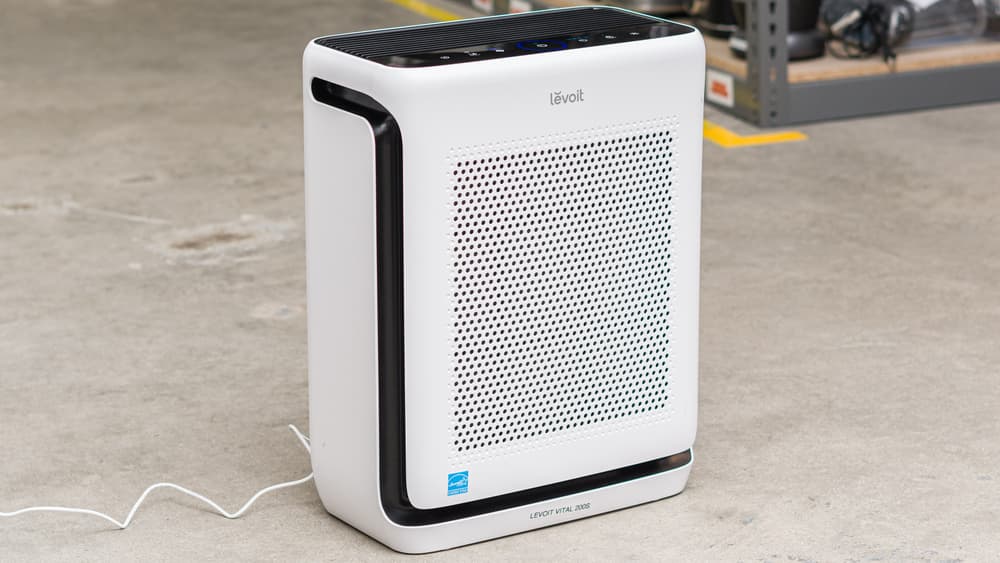
I bought this in March after a week of wildfire smoke turned the western sky orange and my apartment into a sinus headache. I plugged it in on the floor of the living room, set it to auto, and forgot about it for three days. When I remembered, the air quality light had gone from red to blue and stayed there. That is more or less the entire review.
What the Vital 200S gets right is the boring thing: it moves a lot of air through a real H13 HEPA filter without being annoying about it. The side intakes mean you can shove it against a wall, which most purifiers refuse to let you do. On the lowest setting it is genuinely silent — I sleep about six feet from mine and have never noticed it running. On the highest setting it sounds like a window fan, which is loud but not absurd for the amount of air it's moving.
The auto mode is the feature I expected to disable and ended up trusting. It uses a laser particle sensor that actually responds to things — cooking bacon spikes it red within about thirty seconds, and it ramps back down once the air clears. I have had smart appliances whose sensors were clearly decorative. This one isn't.
The app is the weak point and you should ignore it. VeSync is a generic IoT app that wants an account, sends notifications I never asked for, and gives you about three settings you couldn't reach from the unit's front panel. After a week I deleted it and never missed it. The purifier works fine as a dumb appliance, which is how I'd recommend using it.
The filters are the part that quietly matters over years. Levoit sells the replacement HEPA-and-carbon combo for around $40, and you swap it every six to eight months depending on how hard the unit has been working. Compare that to the Dyson tax — $80 filters, sold once a year, on a purifier that doesn't move appreciably more air — and the math gets uncomfortable for the premium brands.
The room-size claim is where Levoit fudges. The marketing says it handles spaces up to about 380 square feet, and that's true if your standard is "keeps the air pleasant." If you want hospital-grade clean in a 380-square-foot room — five air changes per hour, the threshold actual air-quality people use — you're looking at more like 220 square feet. Most apartments have a 200-square-foot living room, so this is fine for most people. It's worth knowing if you're trying to cover an open-plan space.
One real annoyance: the indicator light. Even in sleep mode, the air-quality ring glows faintly, and on a bedside unit it's noticeable in a dark room. There's a button to dim it, but no way to turn it off entirely without unplugging the unit. I put a piece of electrical tape over mine, which solved the problem and made me feel like a person who puts tape on things.
Verdict: Buy this if you want a real HEPA purifier for a bedroom or living room and you don't want to think about it again. If you're trying to clean a whole house, get two of them rather than one bigger Dyson.