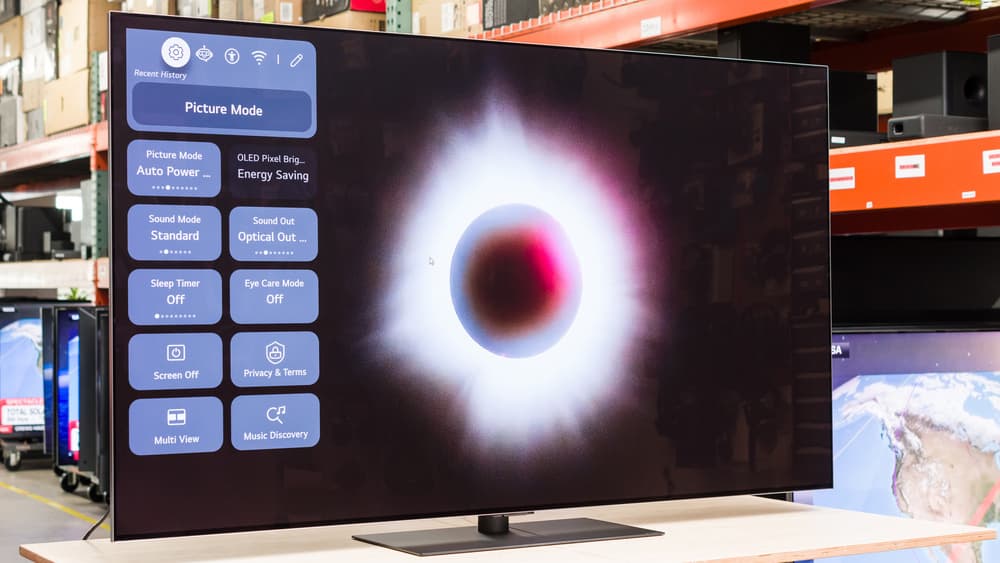
The thing nobody tells you about the G-series is that it's not a TV you put on a stand. The whole industrial design assumes the back of the panel is going to be pressed against drywall. When I unboxed mine there wasn't a stand in the box, just a flush wall-mount bracket and a careful set of instructions for hanging it like a picture. If you weren't planning on mounting, return it and get the C4. The G4 on a credenza looks like a TV being held up by a phone book.
Mounted, though, it's the most architectural television I've owned. The bezel sits less than half an inch off the wall, and from across the room it reads as a black rectangle pressed into the paint rather than a piece of consumer electronics protruding into the space. My partner stopped complaining about the TV for the first time since we moved into the house.
The picture is the part you're paying for. Brightness Booster Max is meaningfully brighter than the C4's panel — not a doubling, but a real, visible bump in HDR highlights, particularly in the 5–10% window where movie content lives. The α11 processor handles upscaling better than anything LG has shipped before; I watched an old Blu-ray of Heat and the grain handling alone was worth the upgrade from my old C9. Dolby Vision Gaming, full HDR, 120Hz at 4K, VRR, ALLM — the spec sheet covers everything a 2026 TV should.
Wide viewing angles are an OLED thing, and the G4 doesn't lose them; in a 77-inch panel with a sectional couch, that matters more than the spec sheet implies. Everyone in the room sees the same picture.
The complaints are real. No ATSC 3.0 on a $4,000+ flagship is genuinely silly — Sony and Samsung include it on TVs at half the price. If you watch over-the-air broadcasts, the G4 will receive ATSC 1.0 just fine; if you want the 4K HDR broadcasts that are slowly rolling out in major markets, you'll need a separate tuner. I have one and resent it.
The other thing I keep reading about and have not been able to reproduce: thermal clicking noises from the back panel as it warms up and cools down. LG's official position is that this is normal expansion-contraction behavior of the chassis. Mine has done it twice in four months, both times briefly. If you're sensitive to small noises and the TV is in a quiet bedroom, factor that in.
The 60W built-in audio is fine for casual viewing and overmatched by any halfway serious movie. Plan on a soundbar. The webOS interface is the same one as the C4, with the same ads on the home screen, which is the same complaint I have with every smart TV in 2026.
The pricing is where I struggle to be enthusiastic. The 77-inch G4 sits around $4,000–4,500 most of the time. The 77-inch C4 is closer to $2,800. The C4 at 70% of the price is the smarter buy unless the wall mount is the whole point.
Verdict: Buy the G4 77" if you're mounting flush on a wall in a public-facing room and you want the design to disappear into the architecture. If you're putting it on a stand or in a media room, the C4 saves you over a thousand dollars.