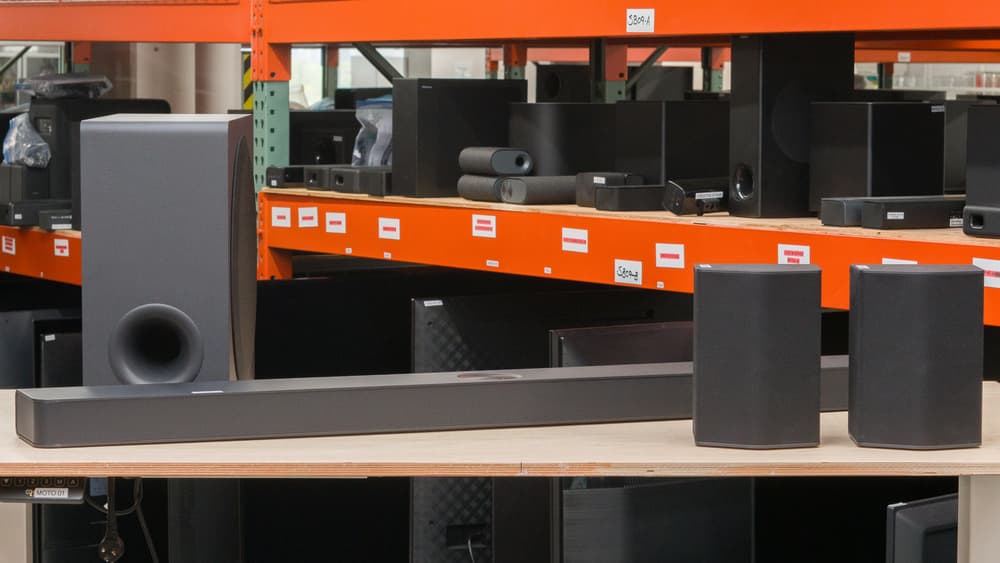
I opened a single carton and pulled out a soundbar, a wireless subwoofer, two wireless rear speakers, and an HDMI cable. That sounds like a small thing until you've spent an afternoon ordering separate components and a $40 cable that should have been included. The S95TR ships as a finished home theater, which is most of the reason to buy it.
LG's marketing calls this a 9.1.5 system, and the company will quietly admit if you ask that the actual Atmos channel configuration is 7.1.4. The extra drivers fill what LG calls "sound shadows" (gaps between the discrete channels), rather than acting as their own beds. In a room with reasonable ceiling height and side walls within a few feet of the bar, this is a distinction without much practical difference. In a wide-open loft, you can hear the side surrounds losing some coverage. Mine is the former, and the immersion held up.
The format support is where this bar gets serious. Dolby Atmos and DTS:X are both genuine, not virtualized. Dolby TrueHD and DTS-HD Master Audio are both decoded. Hi-res audio up to 24-bit/192kHz is supported, and Dolby Atmos over TIDAL Connect works — which is rare enough among soundbars that I tested it twice to be sure. A Pink Floyd Atmos remaster through TIDAL was the first time I've heard music out of a soundbar that made me put down my phone.
The bass goes solidly into the 40 Hz range and stops trying. That's enough for most movies and almost all music; it is not the bottomless low end the 11-channel Samsung delivers with its 8-inch sub. There's also a slight mid-bass tubbiness I noticed on dense rock tracks and the occasional movie scene — bloated kick drums, a touch of boom in low male voices. The AI Room Calibration in the LG Soundbar app trimmed it down but didn't erase it.
At the top, the treble is a little less refined than I'd expect at $1,499. Cymbals sound right; the air around them sounds slightly compressed. This is the kind of detail you notice only if you've spent time with separates at twice the price. If you haven't, you won't miss it.
The bar also gets a little congested when pushed hard — busy Atmos action scenes at high volume start to flatten out instead of staying layered. Backing off four or five clicks restores the imaging. The street price hovered around $1,285 when I checked, which is the right number to pay; at full MSRP the comparison gets tougher against the Sonos Arc Ultra.
The pairing case is real. If you own an LG OLED, the bar's AI Room Calibration acts like Samsung's Q-Symphony — the TV's own drivers and the soundbar coordinate, and the result genuinely sounds bigger than either alone.
Verdict: Buy this if you own an LG OLED and want the complete surround package without a second order. If you're outside the LG ecosystem, the Samsung HW-Q990D is the louder, more ambitious answer.