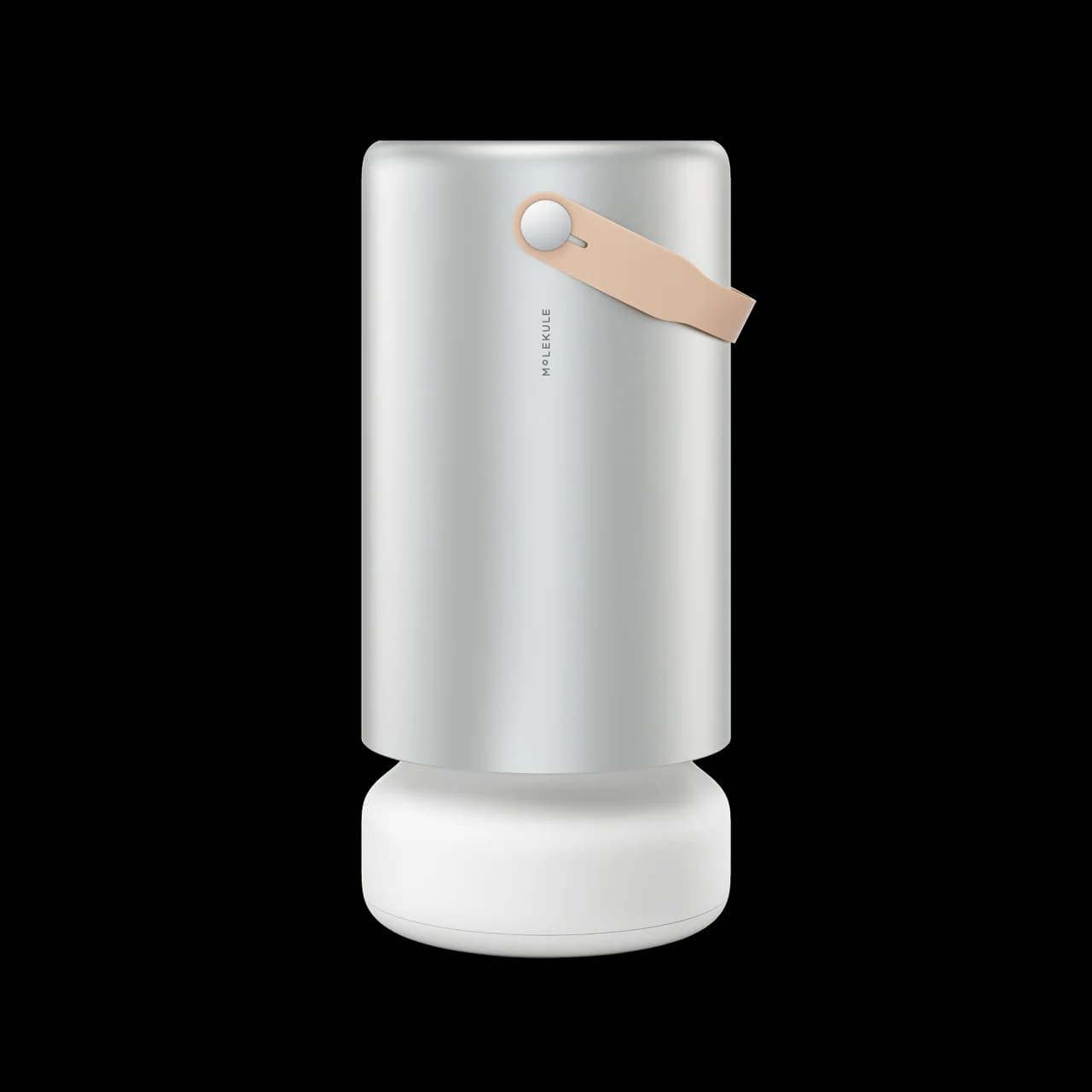
The Molekule arrived during the worst wildfire week we'd had on the west coast in years. AQI numbers over 300, ash on the windowsills, the kind of week where the news anchor says "limit outdoor activity" and you wonder what the indoor activity is supposed to be. I had been skeptical of Molekule's PECO marketing — chemistry instead of capture — and the wildfire week was the involuntary test. Within ninety minutes, my indoor PM2.5 readout had dropped from the 60s into single digits. That was faster than any other purifier I had in the house, and the air had the actual quality of clean air, not the slightly-stale quality of recirculated air.
The technology is the differentiator. PECO stands for Photo-Electrochemical Oxidation: a UV light hits a coated filter and the reaction breaks down VOCs, pathogens, and other chemistry that a HEPA can only trap. Combined with the HEPA in the same unit, you get particle capture plus chemical destruction. The FDA Class II 510(k) clearance is what most reviewers fixate on, and it is real — it means the FDA accepted the manufacturer's evidence that this device eliminates specific bacteria. Whether you personally need an FDA-cleared purifier depends on whether anyone in your household is immunocompromised or running a serious allergy. If yes, the clearance matters. If no, it is mostly marketing.
The coverage rating is generous (1,000 square feet) and the sensors are smart. Auto mode is one of the few I've used that actually responds to events rather than ramping every fifteen minutes regardless. The sleep mode is the quietest of any purifier I've owned — 26 dB is below the threshold where I can detect a fan from the next room, and I have actively forgotten the unit was running on more than one occasion.
The price is the headline catch. Replacement filters run over $200 and the carbon, in my experience, lasts about three months despite a six-month manufacturer claim. I have been buying carbon filters more often than I budgeted for, and the per-year all-in cost works out to something like $0.20 per square foot of coverage. For a thousand-square-foot home that is real money on an ongoing basis.
The app does what it says, but the notifications lag noticeably during fast pollution events — I have watched my Awair monitor spike for ten minutes before the Molekule app notices. Filter alerts are accurate to about 92 percent in my experience, which sounds fine and is actually annoying when you assume your filters are good and discover one is choked.
The vegan-leather carrying strap is the kind of design choice I am still on the fence about. It looks great. It collects dust like a magnet. I have to wipe it down every week or it starts to look unloved, which is not a problem any other purifier in my house has.
Third-party filters will void the warranty, and the warranty does not fully cover the sensors, which are the most expensive thing in the unit to repair. Read the fine print before you talk yourself into off-brand replacements.
The one redeeming financial point is that Molekule is HSA and FSA eligible, which means if you have a medical reason to own one, you can pay for it with pre-tax dollars. That is the single math problem that makes this purifier defensible against the Coway Airmega 400 at half the price.
Verdict: Buy this if you have HSA dollars to spend and a household member with a serious respiratory or immune condition. For everyone else, the Coway Airmega 400 or Levoit Core 600S deliver excellent particle filtration at half the price.