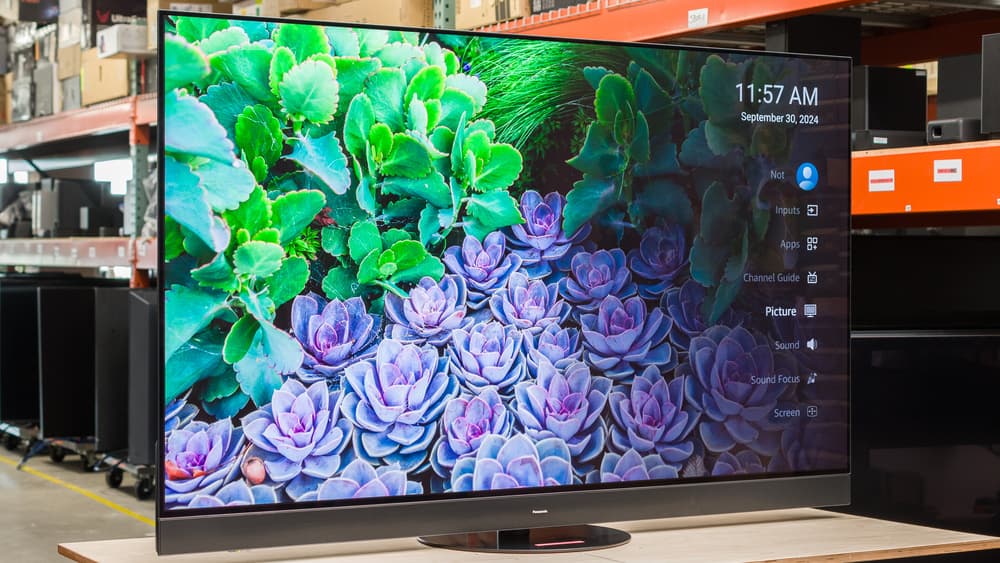
I drove forty minutes to a Best Buy that had one of these on the floor because the local one didn't, and after twenty minutes in the display section I understood why people in the AV forums won't shut up about it. Side by side with an LG G4 and a Sony A95L, the Z95A's picture had a quality I'd describe as "settled" — the same way a well-mastered vinyl pressing has a settled quality next to a streaming track. Same notes, different posture. That's not a measurement. It's the Pioneer Kuro DNA the long-tenured Panasonic engineers carried over, and you can see it.
The panel is described as a 4-layer Master OLED Ultimate, which is industry-speak for a multi-layered emissive stack that pushes highlight brightness past what a standard MLA OLED can do. In practice that means HDR highlights that punch, paired with the deep-black response OLED has always had. Where the G4 wins on outright peak brightness, the Z95A wins on the gradient between dark and bright — shadows have detail, midtones have weight, highlights don't bloom or clip. It's the picture profile of someone whose first concern is film, not store-floor demo content.
The other surprise is the integrated 5.1.2 audio system with up-firing drivers, totaling around 160W. I am not a person who normally believes built-in TV audio. After a week of watching the Z95A without my soundbar plugged in, I started to actually consider whether I needed the soundbar. Dialogue is articulate, the up-firers produce a real height effect with Atmos content, and the bass goes lower than any flat-panel speaker has a right to. It is not a dedicated 5.1 system. It is the first built-in TV audio I've used that doesn't immediately make you reach for an external option.
The MyHomeScreen smart platform is the weak spot, and it's the kind of weak spot that defines the buying decision. Compared to Google TV on the Sony, webOS on the LG, or Tizen on the Samsung, it feels two years behind on app availability, three years behind on responsiveness, and the navigation has the early-2020s smart-TV jankiness I'd hoped we'd left behind. I run an Apple TV 4K into it and pretend the built-in software doesn't exist. You should plan to do the same.
Distribution is the other issue. Panasonic re-entered the US TV market with this model after years away, and availability is patchy — Best Buy carries it, a handful of regional dealers carry it, and that's mostly it. Returns and warranty service are not as frictionless as on the major brands. If you're someone who needs a TV at Costco with a no-questions return policy, this isn't that.
At around $3,200 for the 65-inch, you're paying the same as a G4 or A95L without the brand recognition. That math only makes sense if the picture profile and the built-in audio are things you specifically want.
Verdict: Buy the Z95A if you care about cinematic picture tuning above all else and you'd rather not own a separate soundbar. Everyone else is better served by the Sony A95L.