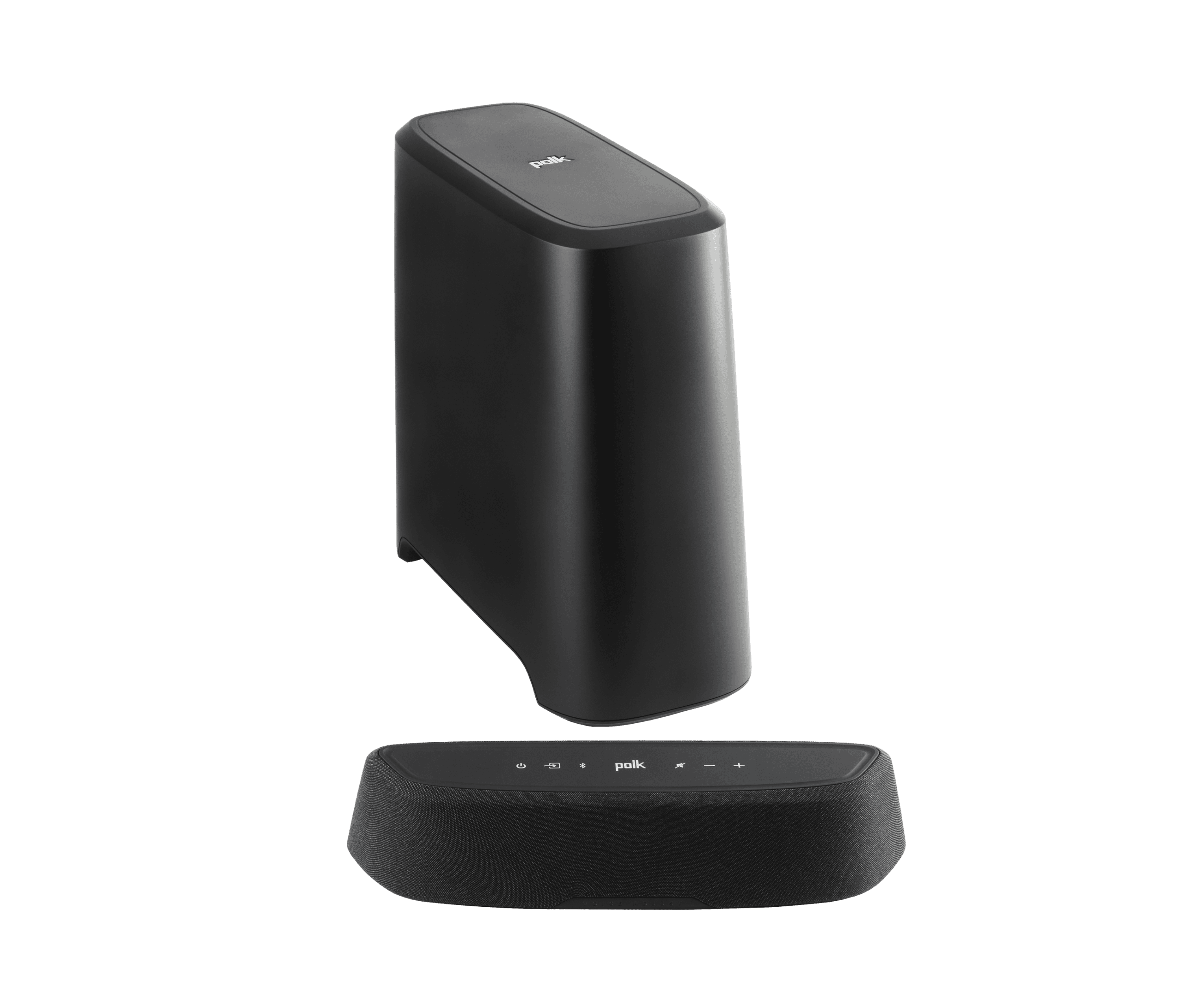
My TV sits on a credenza that's exactly 18 inches deep and impossible to wall-mount above. Every soundbar I've looked at since I moved in has been too long, too tall, or too deep. The MagniFi Mini AX is 14.4 inches wide, 4.1 inches deep, and 3.1 inches tall — which is to say it disappeared under my screen like a center channel and gave me back the entire span of the credenza.
The size is the whole reason this bar exists, and Polk did not sacrifice the subwoofer to get there. The wireless sub that ships with it is genuinely good — bass you can hear and feel, without the boomy single-note thump that comp-priced soundbar subs tend to default to. Mad Max explosions land. Dune spice harvesters rumble. I expected the sub to feel like a compromise; it felt like the headline feature.
Polk's SDA processing is the second pleasant surprise. The bar fakes a wider soundstage by playing with phase cues, and on stereo music the trick mostly works — the sound feels bigger than the box it came out of. Voice Adjust is the feature I didn't think I'd care about and now use constantly; modern Netflix dialogue mixes are a mess and a single button bumps the center channel up without making everything else loud.
The Atmos story is where you have to be honest with yourself. There are no up-firing drivers. Atmos is virtualized — Polk uses processing to suggest height information, and the suggestion is more polite than convincing. I A/B'd it against my friend's Sonos Beam Gen 2 and the Beam wasn't dramatically different at the same trick, but neither bar will give you anything like the overhead placement a real up-firer (or a Sonos Arc Ultra) delivers. Oddly, the cheaper Polk Signa S4 reportedly handles Atmos rendering slightly better, which is a strange place to land for the more expensive bar.
The midrange is the second compromise. On music streaming, vocals and acoustic instruments feel a touch hollow compared to a Sonos Beam or even the cheaper Yamaha YAS-209. It's not bad. It's a step down from those bars on stereo music specifically, which matters if you spend more of your listening time on Spotify than on movies.
The practical limits: HDMI ARC/eARC or optical for input (not both, no passthrough), no manual EQ (four preset modes, no custom curves), external power brick instead of an inline cable, no wall-mount option. Wi-Fi with AirPlay 2 and Chromecast are both here, which is the table stakes Polk got right. Warranty is one year on amps, three on speakers — fine, not generous.
Four hundred and ninety-nine dollars is the right ballpark for what this delivers in a 14-inch box. The optional $200 wireless rears would give you proper surround if you have the outlets, though at that point you're at $700 and the math against a Sonos Beam Gen 2 setup gets harder.
Verdict: Buy this if your TV cabinet is small and your priority is real bass over real Atmos. If overhead immersion matters, step up to the Sonos Beam Gen 2.