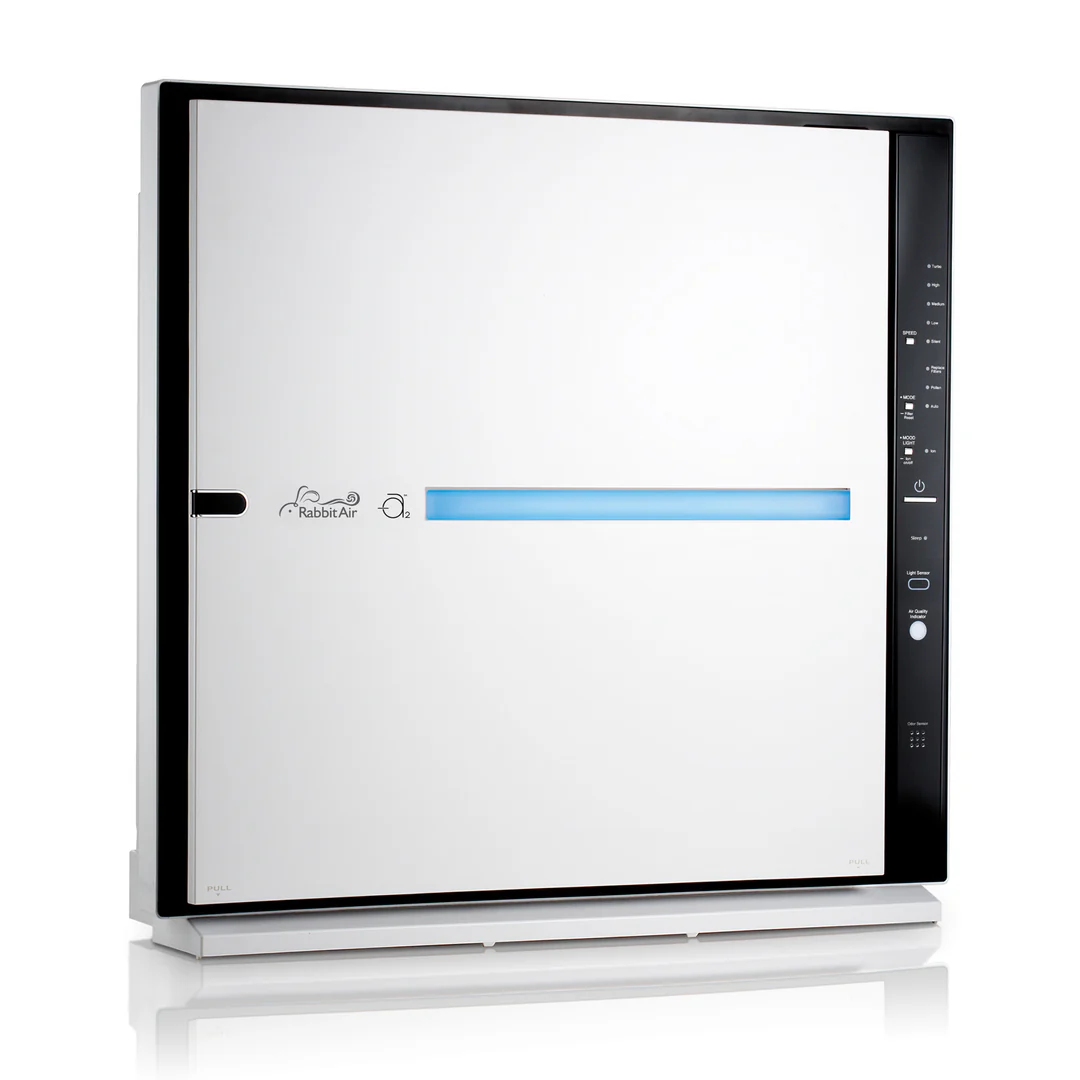
I rent a 600-square-foot studio in Brooklyn where every square inch of floor counts and I have a cat. The MinusA2 came home with me because it was the only purifier I could find that would not eat any floor space at all — it bolts to the wall like a flat-panel TV, sits about seven inches deep, and the front cover I picked has a stylized koi on it. Visitors have asked whether it is a piece of art. It is, until I tell them what it is, and then it is an air purifier.
That is the entire pitch and it is a real one. Nobody else makes a wall-mountable purifier at this performance tier. If you live in a small space, this matters more than the spec sheet suggests. I have it mounted above the couch, three feet off the floor, and I have stopped thinking about it as an appliance. The mounting hardware is included, the installation took me about forty minutes including the part where I went to find a stud finder, and the unit has been on the wall ever since with no rattling, no wobble, no drift.
The filtration is the other reason to consider it. Six stages: a washable pre-filter, a medium particulate filter, the BioGS HEPA layer, a customizable fourth filter (you pick one of Germ Defense, Toxin Absorber, Pet Allergy, or Odor Remover), an activated carbon layer, and a negative-ion stage. I picked Pet Allergy because of the cat. A friend with a smoker neighbor picked Odor Remover. The customization is the kind of feature most companies talk about and nobody else actually ships.
In use it is whisper-quiet at the lower speeds — the published 25 dB sleep mode is real, and I run it overnight without registering it. On high it gets up to around 51 dB, which is fine in a living room and a little much in a small bedroom. The onboard particle sensor and auto mode work well enough that I have not touched the manual controls in months. The light sensor that switches it to sleep mode when the room goes dark is the kind of polish I have come to expect from Korean appliances and find missing from American ones.
The app is the bad part. The Rabbit Air app has dropped my Wi-Fi connection more times than I can count, and when it does work it is laggy and overdesigned. I gave up on it after a month and use the physical controls. If smart-home integration matters to you, this is not the right purifier — the unit is good, the software is not.
The filter-replacement indicator is also smaller than it should be. It is a tiny light on the front panel that I have walked past for weeks without noticing, and by the time I noticed, the filter was overdue. I now set a phone calendar reminder.
The CADR figures are lower than equivalent-priced flagships — 180 to 200 across smoke, dust, and pollen, where the Coway Airmega 400 is doing 300-plus. If you are buying on pure cleaning performance per dollar, the Rabbit loses. What it offers instead is the form factor, the customization, the five-year warranty (which is best-in-class outside the IQAir), and an aesthetic that does not feel like infrastructure.
Running cost works out to about $169 a year if you buy genuine filters. Third-party kits exist for about $60 and Rabbit Air does not love this fact, but the warranty implications are less aggressive than Alen's — generics will not automatically void it, but a generic-related failure won't be covered.
Verdict: Buy this if you live in a small apartment, you want the purifier off the floor, and you have a specific household concern the customizable filter addresses. If you have the floor space, the Coway Airmega 400 cleans harder for less.