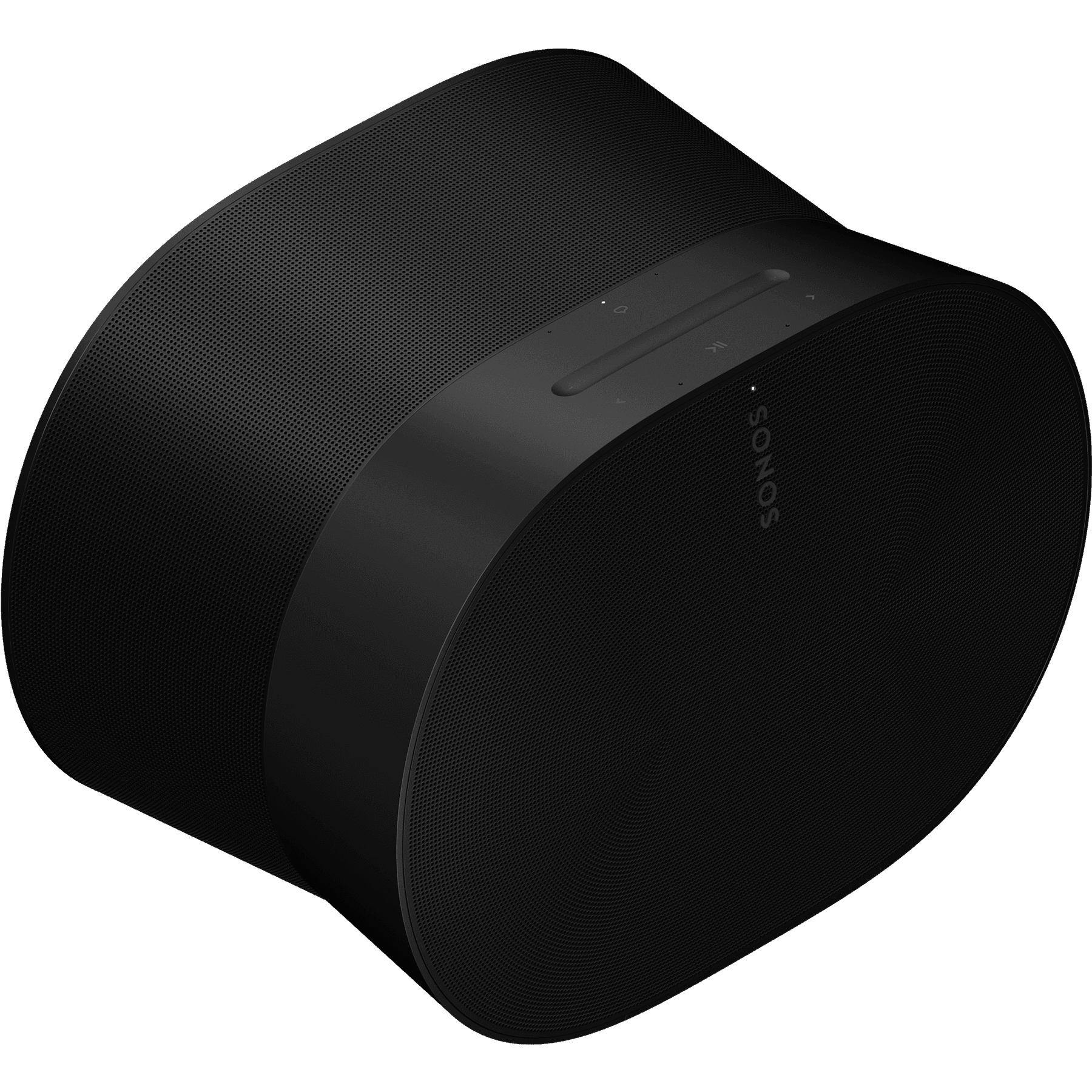
I bought a single Era 300 first, which was my mistake. The oval cabinet sat on my dining room shelf and made a lot of bass and a slightly confused midrange, and I spent two days running Trueplay over and over trying to get vocals to come forward. After the third pass it finally did, and the speaker started sounding like a $449 speaker should, but the experience left me convinced this was a strange product to sell as a standalone.
Then I bought a second one and paired both with my Sonos Arc, and the strange product made sense. The Era 300 is built for Atmos surround duty. The four tweeters and two woofers are arranged to throw sound in multiple directions on purpose, because rear surrounds in a Dolby Atmos setup are supposed to bounce sound off walls and ceilings. On its own, the geometry is a curiosity. Behind a couch, paired with a Sonos soundbar, the geometry becomes the point. Atmos mixes have actual height. Helicopters fly over the room. The first time I watched something with this setup I had to stop the movie and check that the speakers were really doing what I thought they were doing. They were.
What Sonos gets right beyond the Atmos use case is Trueplay, which on the Era 300 is more impactful than on any other Sonos product I've used. The default tuning is bass-heavy in a way that obscures vocals on most music; Trueplay genuinely fixes it. After calibration, classical and acoustic music become listenable, and Atmos music tracks — the ones Apple Music has been quietly tagging for the last two years — start to open up in a way they don't on a regular stereo speaker. Connectivity is the usual Sonos full house: Wi-Fi, AirPlay 2, Bluetooth 5, and a line-in via a USB-C adapter that Sonos sells separately because of course they do.
The complaints are familiar Sonos complaints. The EQ in the app is limited to bass, treble, and a loudness toggle — there's no parametric anything, no per-track adjustment, nothing the audiophile press would consider real. The software has had a rough year; AirPlay to YouTube has stuttered for me, and Spotify has occasionally lost its place mid-track in a way that no other speaker on my network does. Setup requires a Sonos account and asks for your location, which I'd describe as overreach.
And then there's the price. $449 each is premium, and the speaker is most useful in pairs, which means the real cost of getting the experience this product was designed for is closer to $900 — plus the soundbar you're presumably pairing them with. If you already have an Arc or a Beam, that math is fine. If you don't, the entry price keeps climbing.
Verdict: Buy two if you already own a Sonos soundbar and you want true Atmos rears. As a standalone music speaker for the same money, a pair of KEF LSX IIs will outplay it.