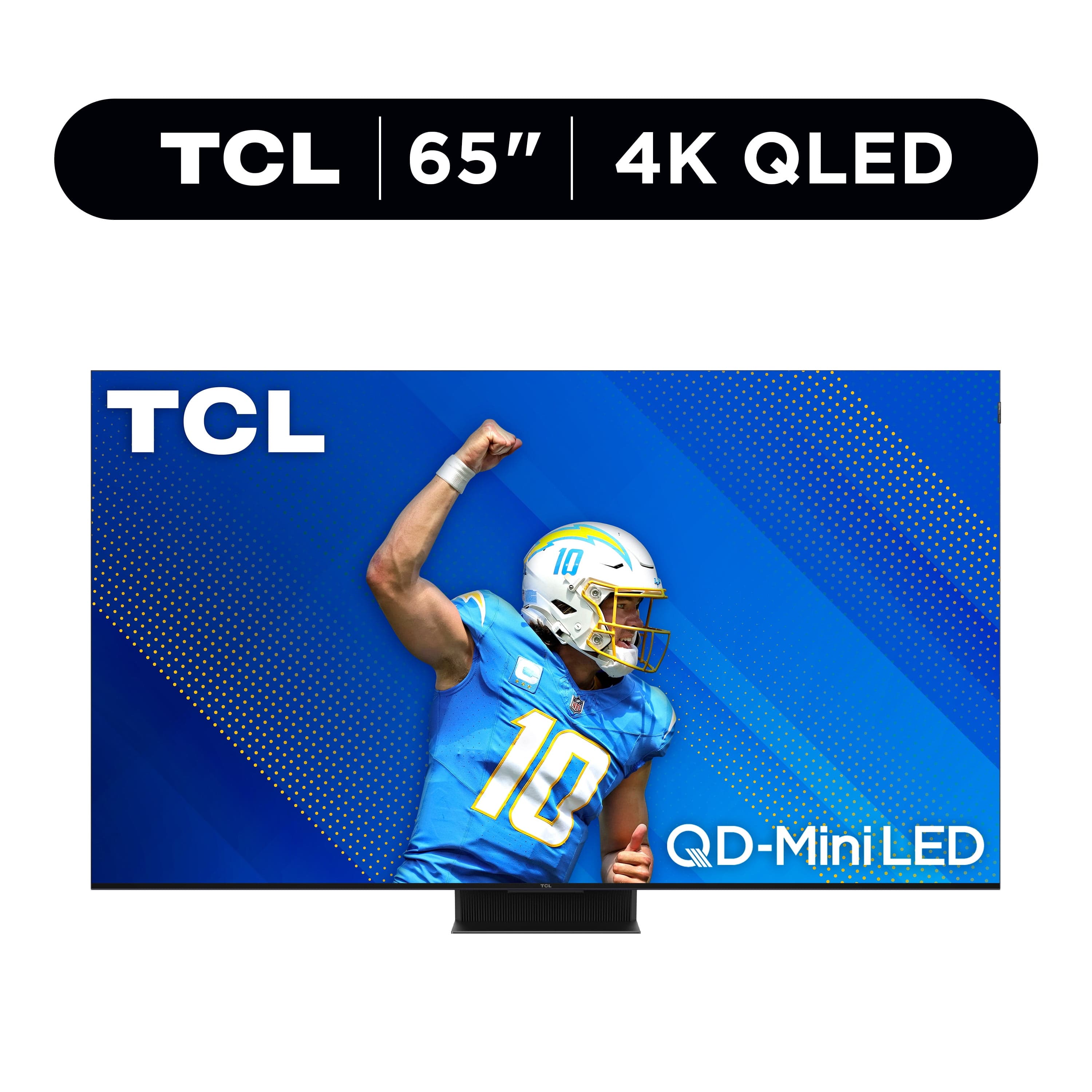
I helped a friend hang an 85-inch QM8 in his basement and spent the rest of the afternoon trying to find something wrong with it that would justify the LG G4 he'd asked me about. I came up short. At $2,200 for an 85-inch TV that pushes 2,500 nits and has functionally invisible blooming on-axis, the OLED conversation gets harder to have without feeling like a snob.
The panel pushes HDR brightness past 2,500 nits consistently — bright enough that some review test equipment hits its measurement ceiling — and pairs it with enough dimming zones that bright content on a dark background just doesn't bloom the way Mini-LEDs used to. On-axis, you'd be hard pressed to call out the difference from an OLED in a side-by-side with normal content. Off-axis is where you start to see the Mini-LED tell: contrast falls off slightly at wide angles. From a normal couch, in a normal living room, the panel reads as a flagship.
The 85-inch and 98-inch sizes are where the QM8's value proposition becomes a math problem nobody can win against it. An 85-inch LG G4 is more than double the QM8's $2,200. For an 85-inch screen on the wall of a family room where the family watches sports and Netflix and the occasional movie, you'd have to be deeply invested in OLED black levels to justify the gap.
Gaming is fully covered: 4K at 144Hz, VRR, ALLM, low input lag. I played a long stretch of Forza on this and it behaved like a gaming monitor that happened to also be a TV.
The trade-offs are real. There's some judder on 24fps content — perceptible if you watch a lot of theatrical films in their native cadence, fine for streaming. Black levels are slightly crushed compared to OLED because there's no pixel-level dimming; dark scenes lose a small amount of shadow detail in service of inky blacks. Black frame insertion exists but is flickery enough that I wouldn't use it. The anti-glare coating is inconsistent at sharp angles — bright reflections still happen at some viewing positions.
The smart side is Google TV, with the same ad-heavy home screen complaint I have about every TV in 2026. The built-in speakers are fine for daytime TV and embarrassing for movies; budget for a soundbar.
The one size I'd hesitate on is the 98-inch at $10,000. At that price the value math that defines the QM8 collapses — you're in custom-installation OLED money, and the OLED options at that size are genuinely competitive. If you want a TV that fills a wall, look at the 85-inch first.
If you're an enthusiast who watches Criterion Blu-rays in a blacked-out room and notices things like grain structure and gamma rolloff, get an OLED. If you're a normal household watching normal content in a normally-lit room, the QM8 is the easiest "yes" in the lineup, and the bigger sizes are where the deal gets ridiculous.
Verdict: Buy the QM8 if you want a big-screen TV in a moderately bright room and you've been priced out of a comparable OLED. Movie purists with a blacked-out room should still get an OLED.