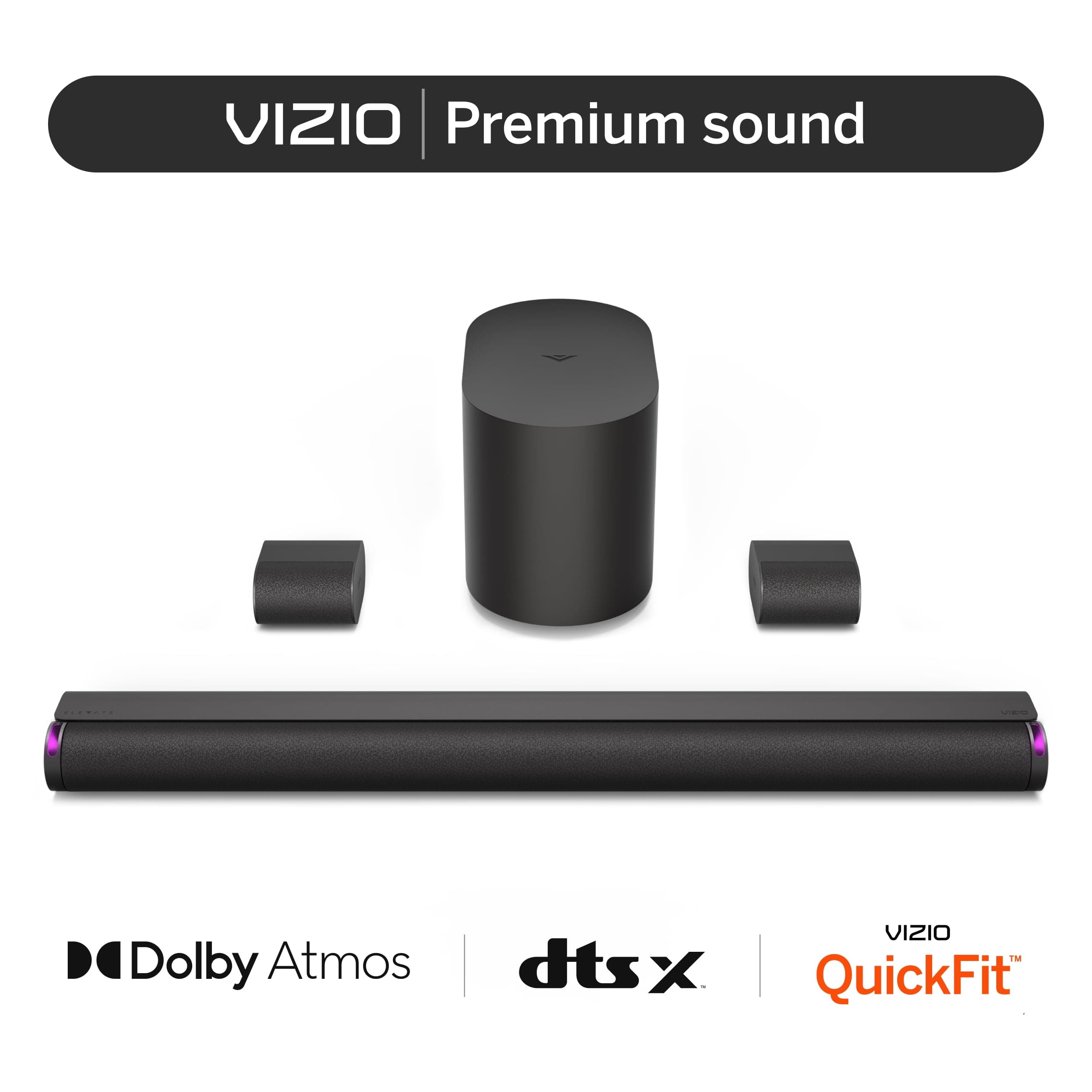
The first time the rotating speakers on this bar swiveled themselves out of music mode and into movie mode, I stopped what I was doing to watch. The mechanism is theatrical in a way Vizio almost never is. Two drivers on each end of the bar tilt up to ninety degrees — pointed forward when you're listening to music or playing a video game, pointed at the ceiling when an Atmos or DTS:X track shows up. It is gimmicky in the best sense: the bar literally rearranges itself to do its job.
The sound, once you set it down on a surface and run the auto setup, is genuinely good. The 8-inch wireless subwoofer reaches down to 30 Hz, which is deeper than any sub in this price bracket has any business going, and the bar puts out a claimed 107 dB without distortion. I never tested that limit; I did test "loud enough to annoy my upstairs neighbor," and the bar handled it cleanly. The wireless surround speakers come with their own up-firing drivers, which is a small but meaningful detail in a 5.1.2 system — Atmos overhead effects come from both the front of the room and behind you, not just the bar.
The rotation works best when you have a flat ceiling at a reasonable height. My room has eight-foot ceilings and the upward bounce is convincing. A friend's room has vaulted ceilings going up to fourteen feet, and the Atmos effect there mostly disappeared into the rafters. This isn't a quirk of the Elevate SE specifically (every up-firing Atmos system has the same constraint), but it's worth knowing before you commit. If your ceiling is angled, textured, or unusually high, the headline feature is wasted on your room.
The meaningful step down from the original Elevate is the height channels. The original was a 5.1.4 system with four upward-firing drivers; the SE drops to 5.1.2 with two. In practice, this is a smaller loss than the spec sheet implies (the additional channels mostly added redundant coverage rather than discrete placement), but for purists who already own and love the original, it is a real downgrade.
The other catch is the pricing. MSRP is $799.99, but the bar showed up at $475 on Amazon and $598 at Walmart on the same day, which makes it almost impossible to know what to actually pay. If you can land it under $500, this is one of the best Atmos values on the market. At $800 MSRP, the comparison gets harder — a Sonos Beam Gen 2 plus a Sub Mini hits similar money and delivers cleaner overall sound, just without the rotation theater.
Connectivity is competent rather than generous. Bluetooth 5.3, HDMI eARC, Chromecast built-in, and QuickFit pairing for compatible Vizio TVs. No AirPlay 2, no Spotify Connect baked in, no Wi-Fi multiroom story. If you're a Vizio TV owner, the in-house pairing matters. If you're not, the Vizio-ecosystem features are wasted on you.
Verdict: Buy this if you want auto-rotating-speaker theater at sale prices and your room has a normal flat ceiling. If you want cleaner Atmos in a single box, save up for the Sonos Arc Ultra.