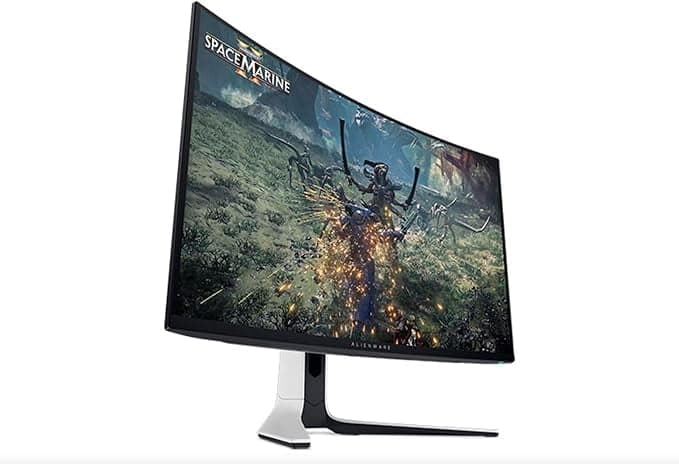
I had been waiting for this monitor for about two years before it shipped, in the sense that I had been waiting for any 4K/240Hz OLED to land under fifteen hundred dollars. When it arrived I plugged it in and spent the first hour just moving windows around to watch the motion. After a decade of LCDs, OLED scroll smoothness still feels like a parlor trick — text doesn't smear when you flick a page, a panning camera in a game stops looking like a strobe.
The color is the part you weren't expecting at this price. Out of the box mine measured a 0.42 average color error, which is the kind of number Eizo charges three times as much to deliver. Coverage is 100% sRGB, 98% DCI-P3, 94% AdobeRGB, and the consequence is that this is a monitor you can edit on in the morning and game on in the evening without flipping presets. Dolby Vision support is rare in a PC monitor and a genuinely useful inclusion if you watch HDR movies at the desk. G-Sync and VESA AdaptiveSync 240 both certified, 240Hz across DisplayPort 1.4 and both HDMI 2.1 ports — no asterisks about which input you have to use.
The curve is a personal-taste question that the spec sheet can't answer for you. 1700R on a 32-inch panel is gentle, and after a week I stopped noticing it for gaming and writing. For spreadsheets and CAD, the straight lines on the screen stop being straight, and that bothered me enough that I'd nudge anyone with a heavy productivity workload toward the flat LG alternative.
The HDR brightness is the soft spot. A 10% window hits about 480 nits, a 50% window 306, full screen 220. That is decent for OLED and embarrassing next to a good Mini-LED, which means in a bright room a Bravia 9 or a Samsung S95D will pop harder than this will. In a dim or controlled-light room the QD-OLED contrast more than makes up for the brightness gap — the blacks are real blacks, not just dark grays — but if your desk faces a window all day this is something to feel out before you commit.
The stand is bigger than it needs to be and ate more depth than I expected from my desk. Burn-in remains the OLED asterisk, and if you leave a static Slack window open eight hours a day for three years, you should expect to see it eventually; Dell's three-year warranty covers it, which is more than most. SDR peak is around 240 nits, which is fine indoors and not enough on a sunny desk.
The pricing is the headline. At $1,199 this is a monitor that made the $2,000 first-generation 4K OLEDs look badly priced overnight, and it is the cleanest single-display gaming setup I have used. If you specifically need flat geometry or you live with a window directly behind you, get something else. Otherwise, this is the one.
Verdict: Buy this if you're building a single-monitor high-end PC and you've been waiting for 4K and 240Hz OLED to reach a defensible price. If you can't stomach a curve at 32 inches, the LG UltraGear 32GS95UE-B is the flat sibling at similar specs.