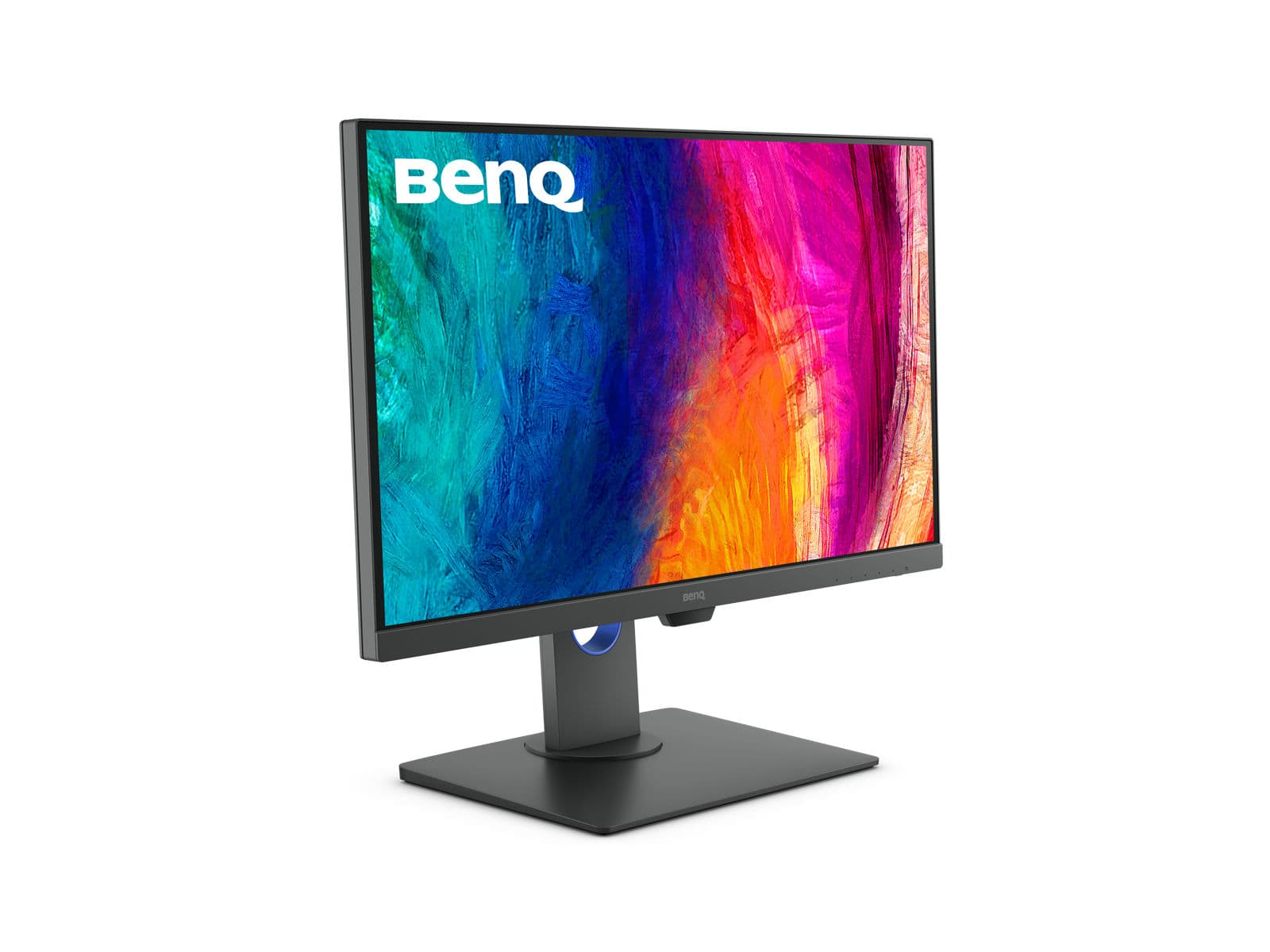
I bought this monitor for a freelance retoucher I share a desk with, and it has been on her desk for two years without complaint. That is a sentence I cannot write about any other display under six hundred dollars. The PD2700U is not flashy, not curved, not high-refresh, and not interesting to write about — and that is what makes it the right answer for a specific kind of professional whose job is to look at color all day and not be lied to about it.
The panel does the things its job description requires. 4K at 27 inches, 10-bit color rendering 1.07 billion shades, 100% sRGB and 100% Rec. 709 coverage. Each unit ships with an individual calibration report in the box, which sounds like marketing until you've owned three monitors with the same SKU that all looked slightly different. The matte anti-glare finish is the other quiet pleasure: in an open-plan office with overhead fluorescents and a window across the room, reflections simply aren't a problem, and a glossy panel of any quality would have made the same desk unworkable.
It is honest about what it is. This is a 60Hz monitor with limited HDMI, and if you also want to game or scroll text at 144Hz it is the wrong purchase. HDR10 is listed on the spec sheet, but at 60Hz with a standard-gamut backlight, HDR here is a checkbox and not a feature. There is no DCI-P3 wide gamut, which rules it out for anyone grading for cinema or finishing for HDR delivery.
What it gets right is what it costs to get those things wrong. A comparable HP Z27 or Dell U2718Q runs roughly $560–$580 at the same color-accuracy tier without the individual factory calibration. An Eizo or an ASUS ProArt at the wide-gamut tier starts at $1,500 and climbs from there. For documentary video editors, sRGB-bound photo workflows, narrative film cuts that don't need P3, and the wide universe of designers who deliver to the web — meaning roughly half of the working creative class — this is the value pick that doesn't make you feel like you cheaped out.
The rotating stand for vertical work is a small thing that I underrated. Half the layouts I review are mobile-first, and the ability to swing the panel to portrait makes that work less of a fight than it should be on a 27-inch display.
The complaints are honest. The OSD is not great. The bezels look like they belong in 2014. The included DisplayPort cable is mediocre. None of these matter if the monitor sits on your desk and shows you the right color for eight hours a day, which it does.
Verdict: Buy this if you do color-managed photo, video, or design work bound to sRGB or Rec. 709 and you don't have $1,500 for a wide-gamut display. If you need P3 or HDR, step up to the PD3220U or accept that the bill is going to climb.