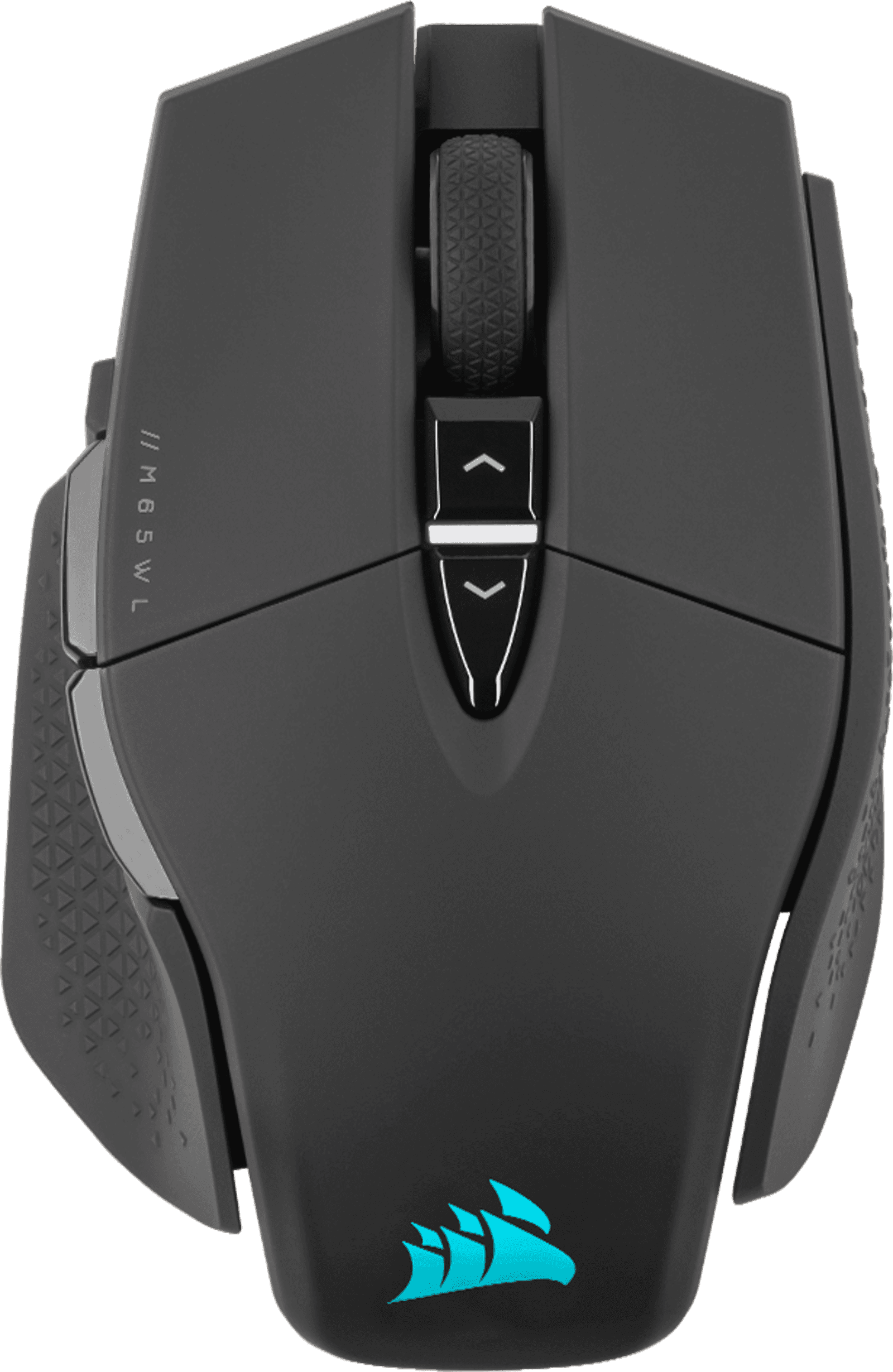
I learned to play Counter-Strike with my thumb on a sniper button. It is muscle memory at this point: hold to drop the DPI, line up the AWP shot, release. The button has been quietly going extinct for years, casualty of the great ultralight reformation, and when I picked up the M65 RGB Ultra Wireless it was the first wireless mouse in a long time that let my thumb fall where my thumb wants to fall. I missed the first two shots, hit the third, and was hooked again.
The sniper button is the reason to buy this. There are maybe three flagships left that still ship one, and only the M65 also gives you tunable weights. The mouse arrives at 110 grams and ships with four small screw-in slugs that take it to 128. I left the weights out. I am not the audience for the weights. But the audience exists, and they have nowhere else to go.
The sensor is fine. Corsair's Marksman tracks cleanly through the kinds of swipes I do in practice servers, and click latency over the 2.4GHz dongle is well under what I can perceive. Polling is rated at 2000Hz and averages closer to 1300 in real-world testing, which is the kind of asterisk that matters only to the people who would never buy this mouse anyway. Bluetooth latency is poor enough that you should treat the Bluetooth mode as a battery-saving travel feature, not a way to play.
The shape is right for claw grip and palm grip both. I've been alternating between this and a Superlight 2 for a month, and the M65 is the one I reach for in a long session. It feels stable. A 110-gram mouse with a wide footprint doesn't dart around under your hand the way a 60-gram puck does, and there's a kind of confidence in that — your aim has more inertia and more follow-through, even if it has less raw flick speed. The thumb rest is generous, the button layout sits exactly where my hand falls, and after a week the mouse stopped feeling heavy and started feeling planted.
The annoyances are the kind you only notice after a week. The weights are a chore to swap; you need the included tool and a flat surface, and once you've committed to a weight you tend to stay committed. The charging cable is the cheap rigid kind that Corsair has been shipping for years, and it fights the mouse when you try to play wired. There's no RGB on the scroll wheel, which feels like an odd omission on a mouse with RGB everywhere else. The iCUE software, as ever, is the price of admission to the Corsair ecosystem and not a feature of the mouse itself.
Battery is a real strength. Roughly 90 hours on 2.4GHz at moderate brightness, and I've gone three weeks between charges without thinking about it. Push the RGB and it drops fast, but that's true of every gaming mouse with a light show.
The real problem is the price. The wired M65 was a $60 mouse that defined a category. The wireless version is $130, which puts it next to a DeathAdder V3 Pro and a G Pro X Superlight 2 — two mice that beat it on weight, sensor, and latency. The M65's case is the sniper button and the tunable weights. If you don't need those, you have better options at the same money.
Verdict: Buy this if your aim depends on a thumb DPI-shift and you want it wireless without giving up the weight tuning.