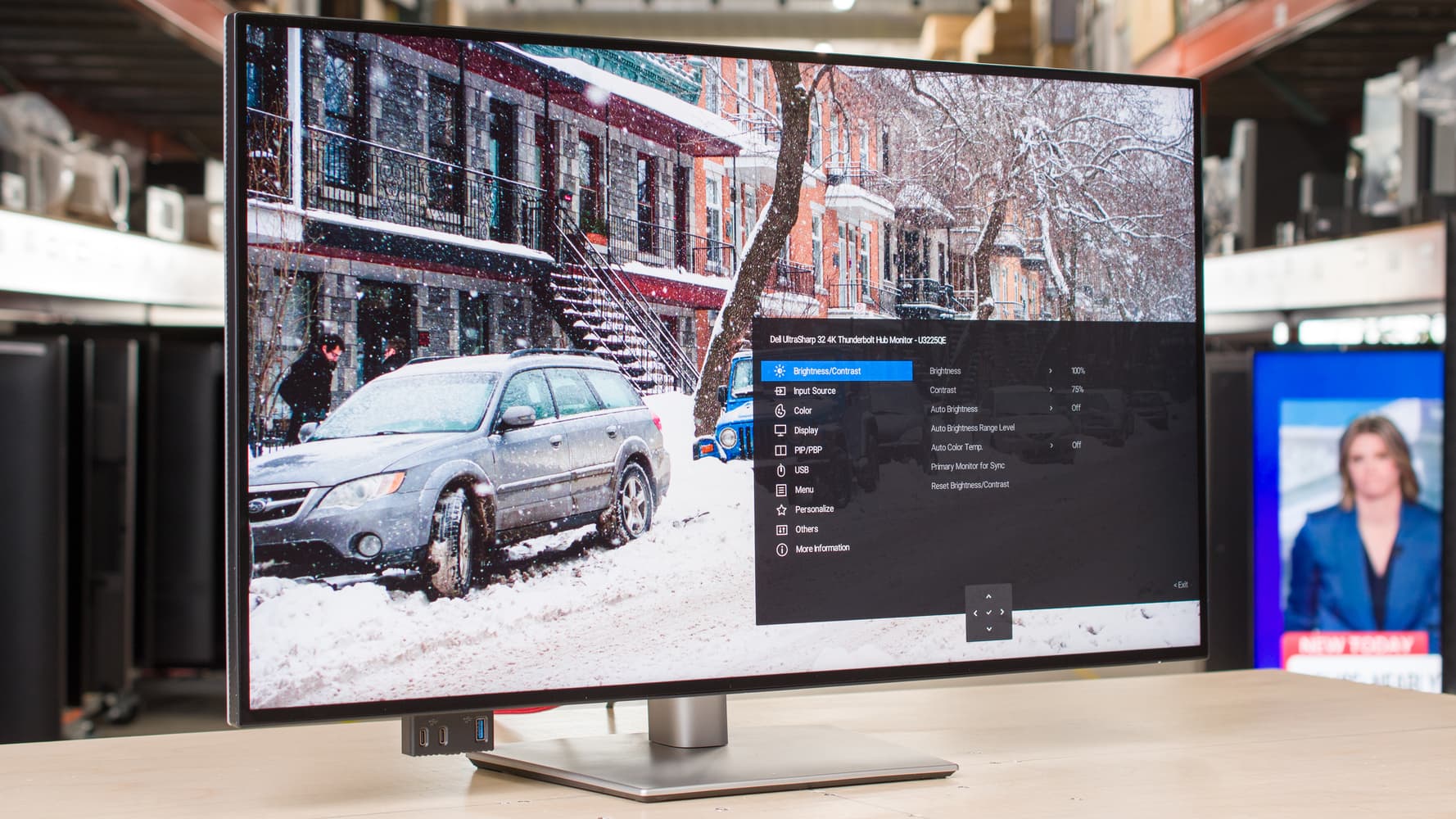
I bought one of these to replace a five-year-old Dell that had finally developed a permanent dim patch in the lower right corner. I wanted to spend twenty minutes setting it up and never think about it again. That is, almost exactly, what happened.
The panel is the part that earns the money. Dell's IPS Black is the first IPS variant where dark scenes don't look like wet slate, and on a 32-inch 4K canvas that's the difference between a monitor you tolerate at night and one you stop noticing. Text is sharp at 140 PPI, color out of the box was close enough to sRGB that I didn't bother calibrating, and the matte coating kills the desk lamp behind me without giving everything that crunchy anti-glare texture some panels have.
The Thunderbolt 4 hub is the under-sold thing. One cable from my laptop charges it at 140W, runs the display, and lights up the Ethernet jack, the USB-A ports on the back, and the USB-C downstream on the side that I use for a webcam. I had a CalDigit dock on this desk for three years. I unplugged it the day this monitor arrived and haven't missed it. That's a real reduction in desktop clutter, and it's the kind of thing you only appreciate once it's gone.
The stand is the third quiet win. It tilts, it swivels, it pivots into portrait, and the height adjustment doesn't sag a millimeter after a month of use. I have owned $1,500 monitors with worse stands.
Where it falls short is anywhere a creative pro would push it. 60Hz means it is not a gaming monitor; mouse movement on the desktop is fine, but if you spend evenings in Apex or Counter-Strike you'll feel the ceiling immediately. HDR is the badge-only kind — DisplayHDR 600 on paper, but no local dimming and middling peak brightness, so HDR content looks washed rather than punchy. And color coverage is sRGB-focused; if you live in DCI-P3 for video work, the ViewSonic VP series or LG's UltraFine line will serve you better.
The other small grievance is the OSD. It is the same five-way nub that Dell has shipped for a decade, and the menus are arranged in the order somebody at Dell finds logical and nobody else does. You'll learn it, but you'll learn it grudgingly.
None of this is the point. The point is that this monitor costs around $900, replaces a dock, looks good in every lighting condition I've tried, and gets out of the way. Most monitors I review have a personality. This one doesn't, and that is the highest compliment I can pay a productivity display.
Verdict: Buy this if you work on a computer for a living and you want one cable, a clean desk, and a 32-inch 4K panel that you'll stop thinking about by week two. If you game or color-grade, look at a Dell AW3225QF or an LG UltraFine instead.