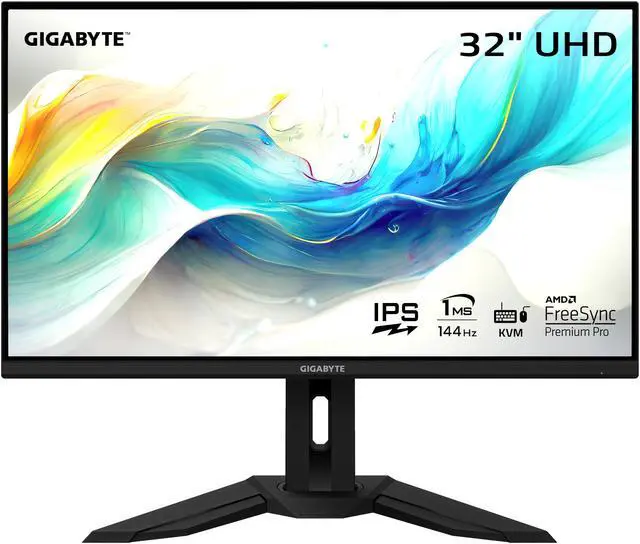
I bought this monitor specifically because I wanted a 32-inch 4K high-refresh display and was not willing to pay $1,300 for the next rung up. Two years later it is still the monitor on my desk, and the reason is mostly that nothing meaningful has shipped in this size and refresh tier at this price. It is not the best 4K/144Hz monitor I have used. It is the one I have, because the better ones cost half again as much.
The panel is a 32-inch IPS at 4K with 144Hz over DisplayPort 1.4 and 120Hz over HDMI 2.1, which is the right combination for a desktop PC plus a PS5 or Xbox plugged in next door. Dual HDMI 2.1 is rarer than it should be in this category, and the built-in KVM that swaps keyboard and mouse between two PCs is the small convenience I use every day — work laptop on one input, personal desktop on the other, no second peripheral set.
The color story is honest and frustrating. Out of the box Delta-E lands at 2.32, which is mediocre and visible to anyone who has used a calibrated monitor. After a colorimeter pass, the same panel drops to 0.5, which is excellent. Coverage hits about 87% DCI-P3. So this is a monitor that ships poorly tuned and rewards the small investment of an hour with a borrowed colorimeter. If you are not going to calibrate it, knock half a point off the score and shop elsewhere.
HDR is the place where the spec sheet is technically accurate and practically empty. DisplayHDR 400 with limited dimming zones means HDR content is brighter than SDR and not much else; there is no real local contrast lift. If HDR matters to you, you want OLED or proper Mini-LED, and neither of them lives at this price point in 32 inches. Treat the HDR as a checkbox and you will not be disappointed.
The complaints around the edges are real. Peak brightness of about 366 nits is fine indoors and not enough for a sunny office. The stand has limited height adjustment and the swivel is awkward — I bought a monitor arm in the first week. The OSD is low-resolution and the control dial does not love being used. Driving 4K at 144Hz in AAA games realistically takes an RTX 3070 or RX 6800 XT or DLSS, so factor the GPU into the budget.
The pricing remains the entire point. The Aorus FI32U and the ASUS ROG Swift PG32UQ deliver similar specs for $200 to $400 more, the Alienware AW3225QF lives in a different price tier entirely, and Apple does not make this monitor. Until someone undercuts $800 for 32-inch 4K and high refresh, this is the budget pick by default.
Verdict: Buy this if you specifically want a 32-inch 4K/144Hz monitor and you're willing to calibrate it after unboxing. If 27 inches works for your desk, a better-tuned 27-inch 4K at the same price is the smarter spend.