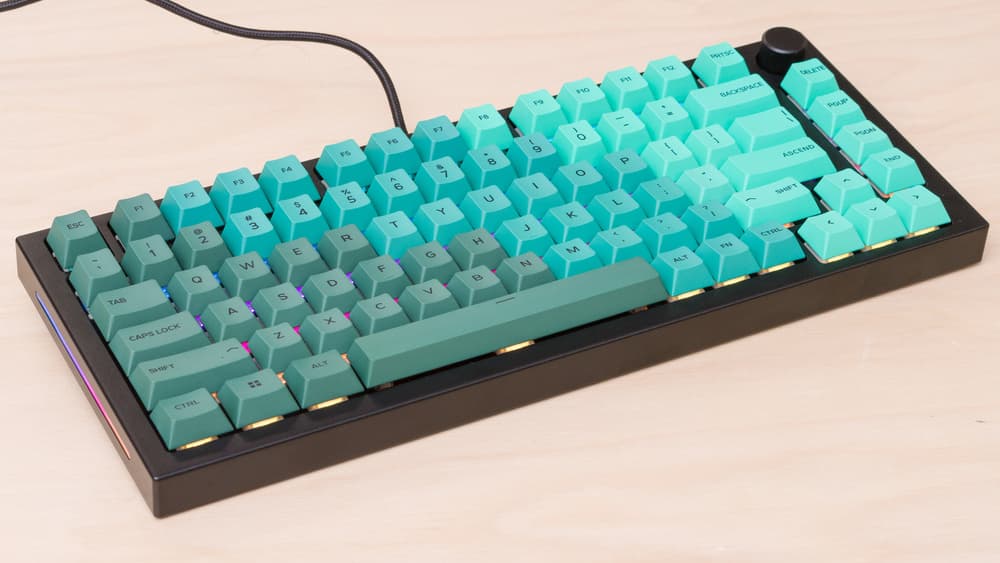
I bought this two years ago to scratch the custom-keyboard itch without committing to a six-month group buy, and it has done exactly that — which is the highest compliment I can pay it. The CNC aluminum case has the heft and dead sound that custom builders spend $400-plus chasing, and the gasket mount gives the typing feel a softness you don't get from a rigid plate-mounted board. The first time I sat down with it I had to stop and listen, because I couldn't hear anything except the switches.
The 75% layout is the right compromise for most desks. You keep the function row, the arrow keys, and a small column of navigation keys; you lose the numpad and a few inches of desk real estate. The rotary knob in the top-right corner is the small touch that makes it feel like a different category of object — by default it's volume, but I have mine mapped to horizontal scroll in Premiere, and once you've used a hardware scrubber for video editing it's hard to go back.
Hot-swap sockets are the real reason to buy this board. Mine came with Glorious linear reds, which I tolerated for two weeks before swapping them for Gateron Ink Blacks, which I tolerated for another month before settling on Boba U4Ts. The platform absorbed all of that without me needing a soldering iron. The same logic applies to keycaps: the stock set is fine, but the case is generous enough to look correct under almost any aftermarket profile you throw at it. With the right switches and caps, this board genuinely rivals customs that cost two or three times as much.
VIA support is the other quiet feature. You configure your remaps in a browser-based tool, write them to the keyboard, and they persist. No daemon running in the background, no companion app demanding updates, no cloud account. If you've used Razer Synapse or Logitech G Hub you'll appreciate how much friction VIA removes.
What the GMMK Pro is missing is what you'd expect at the price. There's no wireless, period — USB-C only, with a non-removable braided cable in the box. The polling rate caps at 1kHz, which is fine for typing and unremarkable for gaming, but won't satisfy tournament FPS players who want the 8kHz Huntsman V3 Pro spec. There are no software macros at the OS level. The stock stabilizers are the weakest link in the build — most owners end up clipping, lubing, or replacing them within a few months, which is the kind of mod the rest of the board is designed to avoid.
The board is also a hobbyist's hobbyist board in spirit, even if Glorious sells it as a turnkey product. If you don't enjoy tinkering, you'll be happy with it out of the box for a while and then plateau. If you do enjoy tinkering, you'll never run out of upgrade paths.
Verdict: Buy this if you've been admiring the custom mechanical scene from the sidelines and want a real foundation that doesn't require waiting six months for a group buy. If you want a complete package with wireless and zero modding, the Keychron Q1 Pro is the same money and a more finished product.