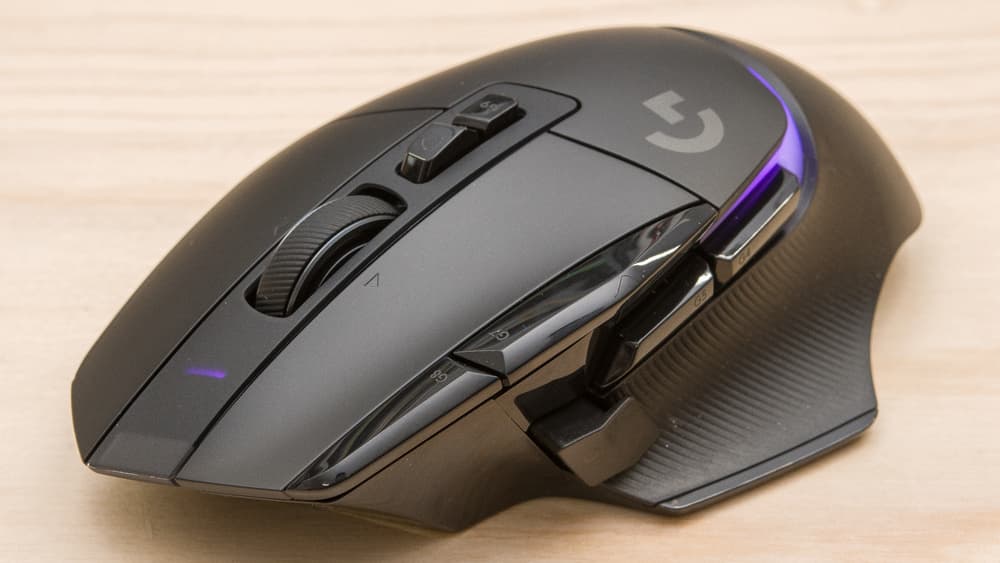
I went back to a G502 after two years on a lightweight 60-gram mouse, and the first afternoon felt like putting on a heavier coat. By the end of the week I'd stopped noticing, and by the end of the month I'd remembered why this shape sold the better part of a decade of Logitech's gaming line. Your hand sits in it rather than on it, and the thumb rest is the kind of small thing that you don't realize you've been missing.
The scroll wheel is still the best on any mouse I've used. The metal hyperfast mode that disengages the ratchet with a button press is the thing I miss most when I use anything else — flinging through long documents or 200-tab Chrome sessions, then clicking back to ratcheted mode for inventory scrolling in a game, is a workflow no other mouse handles as cleanly. After ten-plus years of G502s, Logitech still hasn't been beaten on this one feature.
The Lightforce hybrid switches are the upgrade over the older G502 Hero. They feel snappier, the actuation is more consistent, and I haven't had a double-click issue yet — which, for any long-time G502 owner, is the upgrade that matters most. Wireless feels indistinguishable from the wired version for everything short of the highest tier of competitive shooters.
Battery is around 130 hours with the RGB off, less with it on. I get about two weeks on a charge with the lights low. Powerplay charging on a compatible mousepad is the right answer if you're going to keep this mouse for years, and Logitech still wants $120 for the pad, which is the kind of pricing that has aged poorly.
The weaknesses are mostly about weight and size. At 106 grams this is heavy by 2026 standards — every esports mouse worth naming is 55–75g, and you can feel the difference in long sessions of anything aim-intensive. And the shape is firmly right-hand only, with a thumb shelf and an asymmetric body, so lefties and claw-grippers need to look elsewhere.
The RGB is the thing I find hardest to defend. Logitech put eight zones of programmable lighting on the top, which look fine in a YouTube unboxing and accomplish nothing on your desk where the mouse is under your hand for ten hours a day. It also costs you battery life and about $30 against the non-Plus G502 X, which is otherwise the same mouse. If you don't care about lights, buy the non-Plus.
G Hub remains a clunky piece of software. It works, it lets you remap everything, it has profiles per game — but it also pops up update notifications at 3 a.m. and occasionally forgets which mouse you have plugged in. I've made my peace with it. Others won't.
Verdict: Buy this if you have a medium-to-large hand, you palm or finger-tip grip, and you want a mouse that disappears into your hand for both work and games. If you play shooters competitively, get something lighter; if you don't care about the lights, save $30 on the non-Plus.