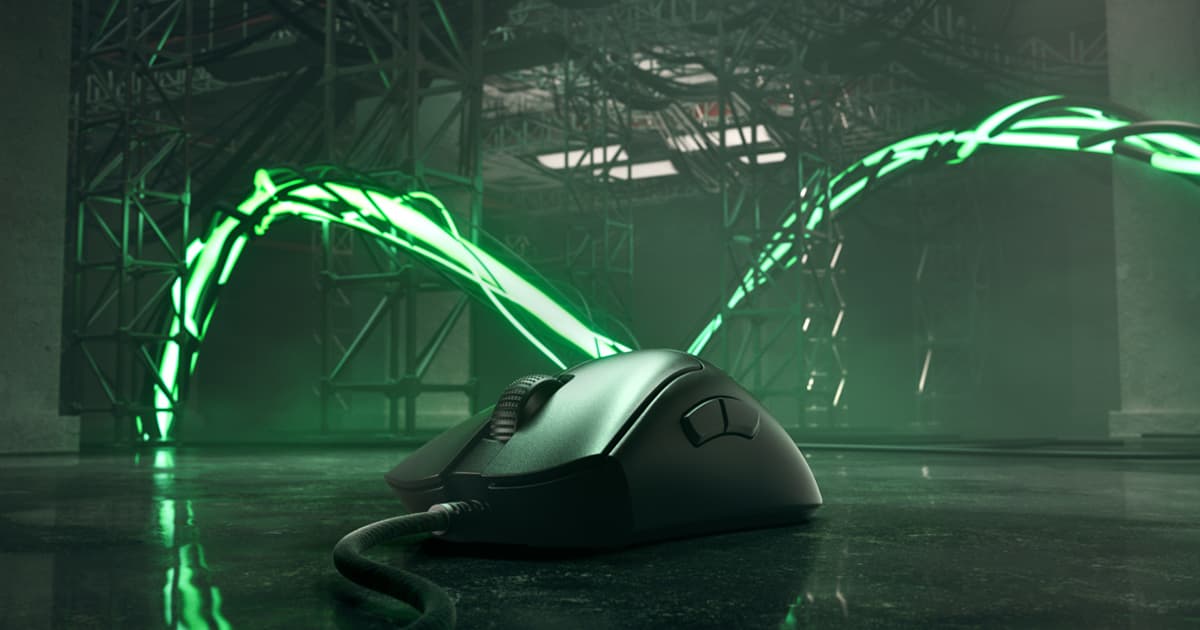
There is a kind of product that you can tell, the moment you pick it up, was designed for a single use case and nothing else. The DeathAdder V3 Pro is that kind of product. It does not have Bluetooth. It does not have a free-spin scroll wheel. It does not have a sensitivity clutch, an RGB ring, or onboard macro storage worth talking about. It has a sensor, a shape, two main buttons, two side buttons, and a 90-hour battery. The mouse weighs 63 grams. That is the whole sentence.
The shape is the first thing that hits you. Razer reshaped the DeathAdder for the V3, boxier than the V2 and tilted slightly differently across the back, and it is the kind of change that loyalists notice immediately. I came from a V2 and spent the first week mildly annoyed. By the second week my palm had reshaped to fit the new mouse and I'd stopped thinking about it. By the third week I was hitting flicks I hadn't hit in years on the older shape. That is either confirmation bias or a genuinely better shape, and after a few months I lean toward the latter.
The Focus Pro 30K sensor is class-leading, which by 2026 standards is a thing that several mice can plausibly claim, and the differences between them are vanishing. What I can say is that across two months of competitive play I never once felt a tracking inconsistency, even on the slow-motion replays where you would notice. The Gen-3 optical switches mean no debounce delay and, more importantly, no double-click drift after the first six months — which has been the death of more gaming mice in my drawer than any other failure mode.
Battery is around 90 hours at the standard 1000Hz polling and drops sharply if you crank it. There's no Bluetooth, which is a real omission for dual-PC users and an intentional one for esports. If you need to play this on a couch with a phone tethered to your TV, this is not the mouse. The included paracord cable is soft and the PTFE feet are smooth from the first second; no break-in period for the glide.
The side buttons have more post-travel than I'd like. The press itself is light, but the button rocks forward another millimeter before it actually clicks, which feels mushy near the edges and great in the middle. I rebound my push-to-talk to the front side button and stopped noticing. The scroll wheel is fine — better than the Superlight 2's, not as crisp as the MX Master's — and I almost never use it during play.
The higher polling rates of 4000Hz and 8000Hz require a separately sold dongle that costs real money, which feels stingy on a $150 mouse. If you have a 360Hz monitor and the eyes for it, you'll want the upgrade. If you don't, the standard dongle is the version most people should be using anyway. The included dongle ships with a small USB-C extension that puts the receiver near the edge of your desk for cleaner signal, which is a small thoughtful touch.
At $149 the DeathAdder V3 Pro is not a value pick. It is the mouse you buy when you have decided that competitive FPS is the reason you have a gaming PC. The fact that Razer has not bolted on productivity features to justify the price is, to me, the cleanest design decision in this whole category right now.
Verdict: Buy this if you play competitive FPS and you want a tool that does that and nothing else.