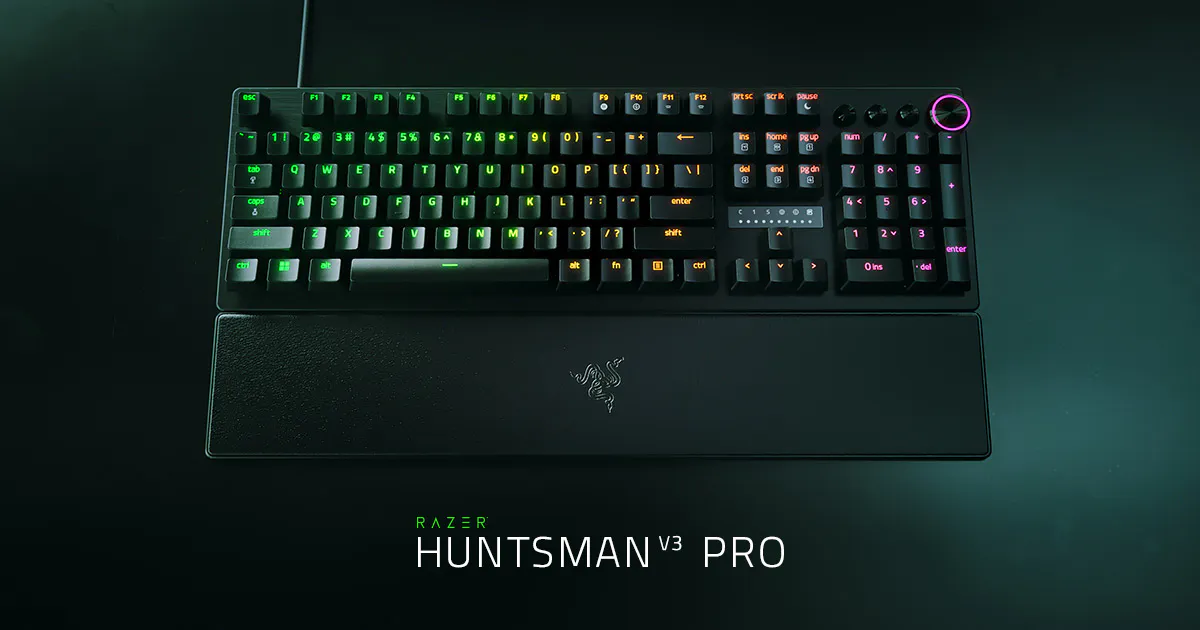
I am not a tournament-grade FPS player, and within an hour of plugging this in I understood that I was using a tool built for someone better at video games than I am. The per-key actuation adjustment is the headline: I set my WASD keys to a hair-trigger 1.0mm for movement and my reload key to a deeper 3.5mm so I'd stop pressing it by accident. After a week of tuning, my deaths in Apex Legends dropped by a measurable amount, which is the kind of sentence I never expected to write about a keyboard.
The HyperTrigger optical switches are the underlying tech that makes the adjustability work. Light-beam actuation means the keyboard can sense not just whether a key is down but how far down it is, in real time. Rapid Trigger lets a key re-actuate the moment you start lifting your finger, instead of waiting for full travel to complete — for movement-heavy games this is genuinely a different experience, and for typing it is invisible. Snap Tap handles the SOCD logic for opposing keypresses, with the usual caveat that some competitive titles ban this feature and you should check before bringing it to a tournament.
8kHz wired polling is the other tournament-grade headline. The 2kHz wireless drops you to a more pedestrian sub-2ms latency, which is fine for everyone except the people this keyboard is actually built for. The wireless mode is also where the 50-plus-hour battery lives, and I got close to 60 hours of mixed use with the RGB off. Three connection modes — wired, 2.4GHz wireless, Bluetooth — switch with a hardware toggle.
The physical build is full-size aluminum, with a media dial in the top-right that I came to rely on for volume in voice calls. The case has the gasket-mounted feel you'd expect from a board at this price, and the doubleshot keycaps feel solid enough to outlast the rest of the desk.
What I cannot recommend is the software. Razer Synapse is required to configure anything meaningful, which means a cloud account, a background service, and a license agreement that nobody reads. If you're someone who blocks startup services, you'll be fighting Synapse the entire time you own this keyboard. The per-key tuning is impressive once you're in there — and it syncs across wired, wireless, and Bluetooth — but the journey to get there is a Razer journey and you know what that means.
The other catches are about value. The proprietary optical switches mean you cannot swap in a third-party switch the way you can with a Cherry MX hot-swap board, which is a real lock-in cost in a category that has spent the last few years moving toward openness. The full-size footprint takes desk space that a tournament player might actually want for mouse arm sweep. And the pricing — $220 to $250 MSRP, around $200 on sale — is a real ask when the Keychron Q1 Pro at $200 covers 90% of the everyday experience for someone who isn't grinding ranked.
The closest competitor is the Wooting 80HE, which is the other Hall-effect-adjacent board in this tier. The Wooting wins on software openness and the OS-agnostic web configurator; the Razer wins on form factor (full-size with media dial) and the wireless option. If you don't need wireless and you hate Razer Synapse, the Wooting is the smarter call.
Verdict: Buy this if you're a competitive FPS player who wants per-key adjustable actuation in a wireless full-size form factor and you can tolerate Razer's software. If you don't need analog actuation, the regular Huntsman V3 or Keychron Q1 Pro will do most of what you actually want for $100 less.