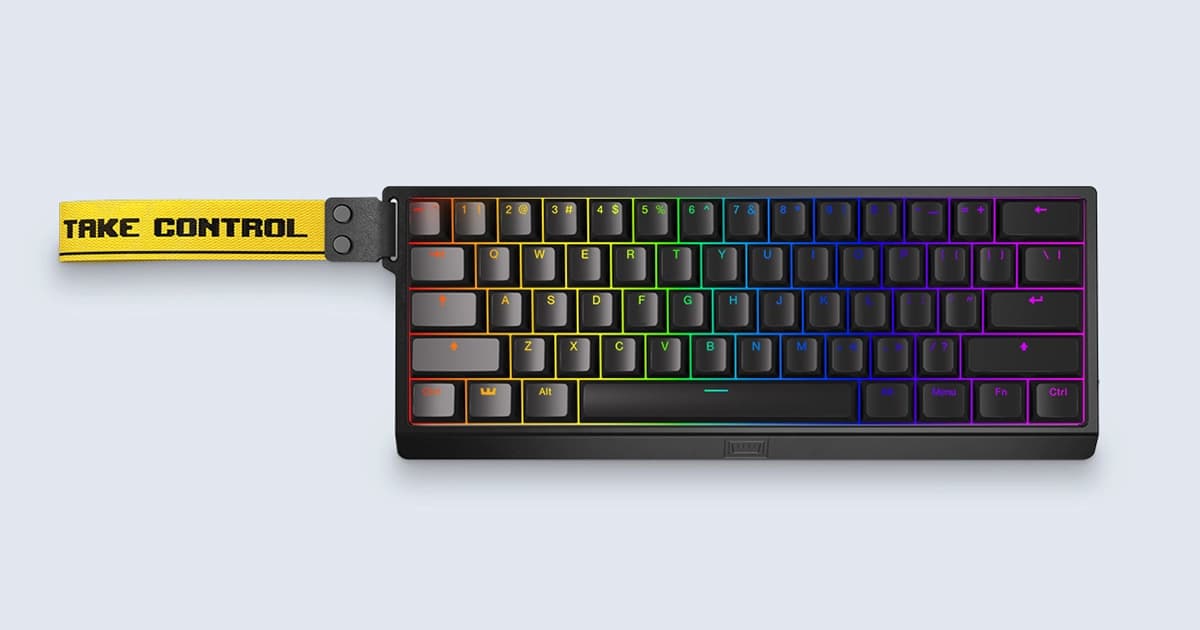
The first thing I did on this keyboard was rebind my space bar to two actions. Tap it lightly to crouch, push it down to jump. That is a thing you can do on this keyboard because the switches aren't on-or-off; they're analog, and every key knows exactly how far you've pressed it. The first time I crouched and jumped from the same physical key in a game of Apex, the keyboard stopped feeling like a keyboard.
The Hall-effect switches are the technology that makes the rest possible. Instead of metal contacts, each switch has a magnet and a sensor that measure depth continuously. The headline benefit is adjustable actuation: I can set my W key to fire at 0.1mm of travel for fast-twitch shooters, and my Esc key at 3.5mm so I don't accidentally rage-quit. The less obvious benefit is the rapid-trigger behavior. The key fires the moment it starts moving up, which makes counter-strafing in CS feel almost embarrassingly easy.
As a typing keyboard, the 60HE+ holds its own. The switches are smooth, the stabilizers come pre-lubed and quiet, and the case has enough mass that it doesn't slide around on a desk. I type roughly 110 wpm and after a week on this board I was back to my normal speed, which is more than I can say for a few mechanical keyboards I've tried to switch to. The sound is more thocky than clacky, slightly muted, with no ping. Out of the box, this is the closest I've heard a stock keyboard get to a mid-tier custom build.
The layout takes adjustment if you've lived on a TKL or full-size. 60 percent means no function row, no arrow keys, no nav cluster. The arrows live on a held-Fn layer with IJKL. I lost about a day of productivity before muscle memory caught up; after that, I stopped reaching. If you write code with heavy function-key use, factor a longer transition.
Wootility, Wooting's configuration software, is the unsung part of why this keyboard works. It runs in a browser and lets you remap anything, layer anything, set per-key actuation curves, and test it all live with a visual depth meter that shows you exactly how far each key is being pressed. I have not used better configuration software for any peripheral, and the keyboard's settings are stored on-board so they follow you to other machines.
The complaints are minor and mostly about what isn't here. The 60HE+ ships wired-only, which in 2026 is starting to feel quaint; Wooting's competitors have wireless analog boards now. There's no per-key RGB tuning of brightness on the fly without going into Wootility. The stock keycaps are PBT and fine, but they're not the same quality as the rest of the board; most owners will swap them within a month.
The other catch is the wait. Wooting still sells in batches, and depending on when you order you may wait two to four months for the keyboard to ship. The company is small, the demand is high, and the queue is real. I waited eleven weeks for mine. I wouldn't wait that long again, but I also wouldn't switch off the keyboard.
At around $200, the 60HE+ is priced below most flagship gaming keyboards and well below custom builds with comparable feel. The competition is mostly other analog Hall-effect boards from larger brands; most are bigger, louder, and worse at the configuration side.
Verdict: Buy this if you play competitive shooters or racing games, you can live without a function row, and you're willing to wait for it to ship.